The Books That Help Artists Survive Their Own Doubt
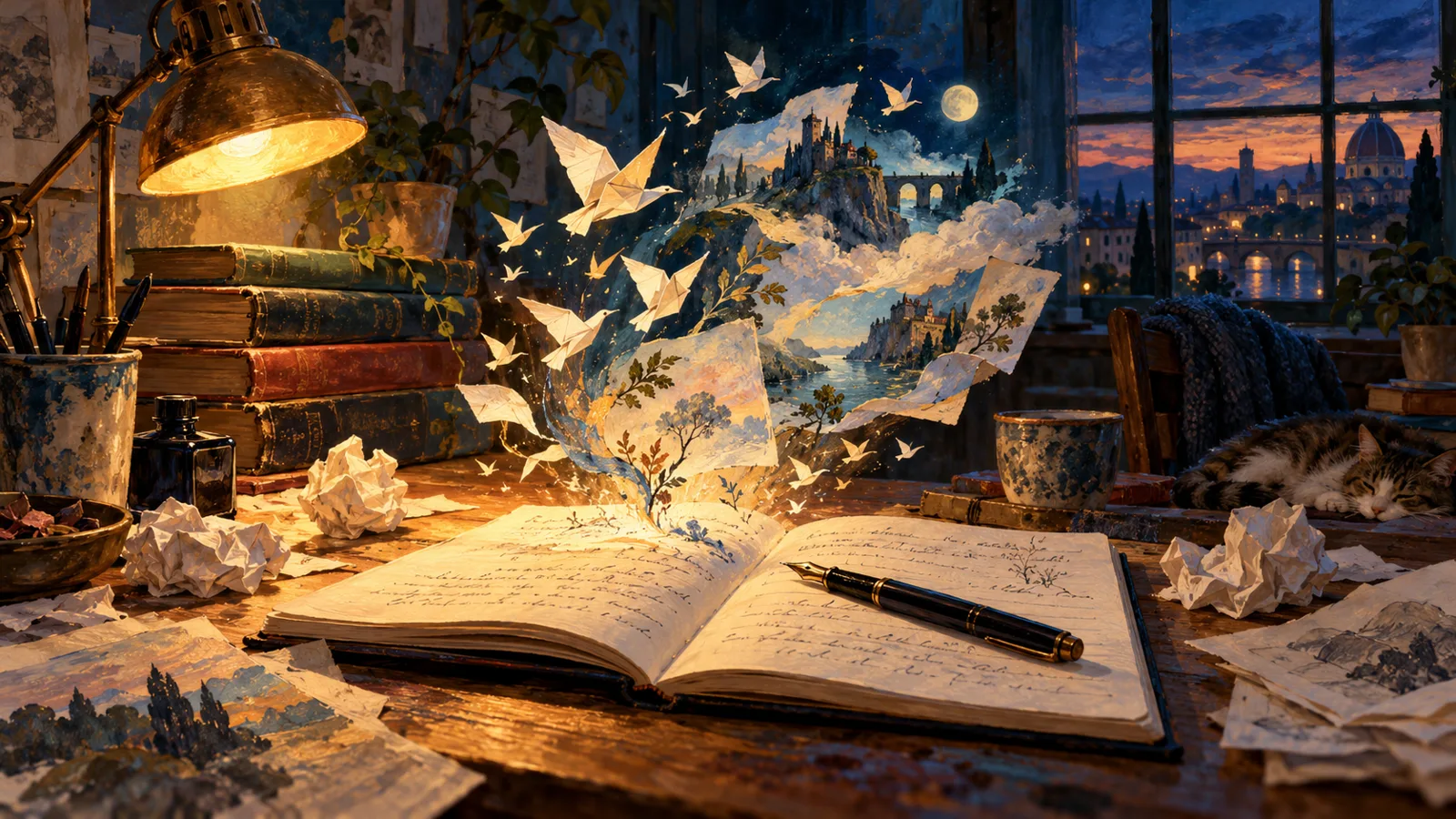
An idea arrives and, for a little while, it is wonderful.
Perhaps it is a novel: a place with its own weather, people with complicated lives, the promise of something funny or devastating. Perhaps it is a painting, a song, a game, or a film. In imagination, the thing has a wholeness that feels almost effortless.
Then you try to make it.
The first sentence is clumsy. The melody sounds familiar. The drawing looks nothing like the picture in your head. Suddenly there are two distinct objections: This work isn’t very good and Who am I to think I could make good work?
A third objection joins them: Even if I finish it, who would care?
These questions can masquerade as artistic judgment. Sometimes there is genuine judgment inside them; a weak paragraph may indeed need revision. But they also have a way of ending the process before it has properly begun. A person who repeatedly deletes every disappointing first attempt never gets much practice turning a disappointing first attempt into something better.
A surprisingly rich shelf of books concerns this exact predicament. Some are manuals, some are meditations, and some are arguments about what artistic work is for. They disagree about discipline, inspiration, and the value of routine. Taken together, they offer something more useful than the command to “believe in yourself”: different ways to keep working without requiring confidence first.
First, distinguish the three fears
“Is this good?” concerns the work. It invites revision, comparison, and craft.
“Will anyone like it?” concerns reception. An audience may be indifferent even to capable work; taste, visibility, timing, and chance matter.
“Am I a fraud?” concerns identity. Here, a bad paragraph becomes evidence against the person who wrote it.
The trouble comes when the questions collapse into one another. A poor draft is treated as proof of a poor artist, and an imagined lack of applause is treated as proof that making anything was foolish.
The books below address different parts of that collapse.
1. Art & Fear — David Bayles and Ted Orland (1994)
Start here if: You abandon work because it falls short of what you imagined.
Art & Fear: Observations on the Perils (and Rewards) of Artmaking is unusually clear-eyed about the ordinary experience of making art. Its subject is not the mythology of the rare genius but the difficulties faced by people who try to produce work again and again: uncertainty, comparison, perfectionism, and the gap between intention and result.
The book’s most important contribution may be its refusal to interpret fear as a special diagnosis. Difficulty is not a sign that the artist has been disqualified. Difficulty is much of the activity.
It is also short enough to read without turning the reading into another elaborate avoidance ritual. Of the books in this article, it is the best single starting point.
Useful takeaway: The fact that the work is not yet what you want is a reason to keep making and revising it, not a verdict on whether you belong.
2. The War of Art — Steven Pressfield (2002)
Start here if: You find yourself doing almost anything except the work you claim to want to do.
Pressfield calls the force behind avoidance Resistance. Under that umbrella he places procrastination, distraction, self-doubt, and the remarkably sophisticated excuses that appear when a meaningful project demands attention.
His prescription is to behave like a professional: turn up, do the work, and stop waiting for the right emotional conditions. It is brisk, combative, and deliberately unsentimental.
This is a useful frame, but not a complete psychology of blocked creativity. Exhaustion, disability, money worries, caregiving, and genuine competing obligations are not necessarily disguised Resistance. The book is at its best when it helps someone recognize avoidable evasion; it is less helpful if read as a moral judgment on every day in which art must yield to life.
Useful takeaway: You can begin before you feel brave or inspired.
3. Big Magic — Elizabeth Gilbert (2015)
Start here if: Your enthusiasm disappears as soon as you imagine strangers evaluating what you make.
In Big Magic: Creative Living Beyond Fear, Gilbert challenges the idea that every creative endeavor must justify itself through money, prizes, prestige, or exceptional originality. A project can be worthwhile because doing it makes a life more interesting.
The book makes room for curiosity and play—two things easily crowded out when every attempt is treated as a referendum on talent. Its account of inspiration can be whimsical or mystical, which will delight some readers and irritate others. You need not accept that account to appreciate the more grounded argument: public success is not the admission price for creative living.
Useful takeaway: You do not need evidence of future popularity before you are allowed to enjoy making something.
4. Bird by Bird — Anne Lamott (1994)
Start here if: You write a few paragraphs, reread them, cringe, and erase them.
Lamott’s Bird by Bird: Some Instructions on Writing and Life is a writer’s book with unusually broad relevance. She is funny about how unpleasant writing can feel, especially when the writer expects a first attempt to possess the ease and authority of a finished book.
Her celebrated defense of bad first drafts matters because it separates generating material from judging material. These are different tasks. Doing them simultaneously is like trying to sculpt marble while insisting that every strike of the chisel leave a finished statue.
A first draft can be inconsistent, awkward, or excessive and still contain an image, sentence, character, or situation worth saving.
Useful takeaway: Write something revisable. The first version need not be something you would willingly publish.
5. The Creative Act — Rick Rubin (2023)
Start here if: The real question is no longer whether the work will be good, but why making art matters at all.
In The Creative Act: A Way of Being, music producer Rick Rubin treats creativity less as a profession than as a way of noticing, interpreting, and responding to the world.
The book is contemplative rather than procedural. It will not tell you how to structure a second act or mix a record. Instead, it asks you to attend more carefully to the conditions in which ideas arise and to recognize the value of the encounter itself.
There is a risk in this approach: its abstractions may feel remote when the practical problem is getting a paragraph written. But it can loosen a particularly punishing assumption—that art only matters if the finished object can be measured, sold, or admired.
Useful takeaway: Making art may be part of living attentively, not merely a scheme for producing impressive objects.
6. The Artist’s Way — Julia Cameron (1992)
Start here if: The block has endured so long that you no longer know how to begin.
Cameron’s The Artist’s Way is a structured, twelve-week program. Its signature exercise, Morning Pages, asks the reader to fill three pages with uncensored, private writing. Another core practice, the Artist Date, is time set aside for replenishing curiosity.
The appeal is mechanical: instead of requiring a grand creative breakthrough, the program gives the blocked person small recurring actions.
Its spiritual language can be a poor fit for secular readers, and no one needs to accept the whole program as doctrine. The practices can still be treated as experiments. Private writing, particularly, offers a place where every sentence need not audition for an audience.
Useful takeaway: A habit of creating in private can rebuild tolerance for imperfect expression.
7. Steal Like an Artist — Austin Kleon (2012)
Start here if: Every promising idea seems too similar to something that already exists.
Kleon’s slim, illustrated Steal Like an Artist attacks the demand that worthy creators produce work without influences.
Artists learn from other artists. They absorb patterns, borrow methods, react against conventions, and combine materials in ways that become increasingly personal. Recognizing an influence does not automatically make a work derivative, although it does not excuse plagiarism either. Transformation and attribution still matter.
This is a helpful antidote to a specific form of impostor anxiety: the thought that encountering a predecessor somehow revokes one’s permission to make the work.
Useful takeaway: Originality is not the absence of ancestry.
8. The Courage to Create — Rollo May (1975)
Start here if: What frightens you most is exposing something personal to the possibility of indifference or rejection.
Psychotherapist Rollo May takes a more philosophical approach. The Courage to Create treats creativity as an encounter with uncertainty: a willingness to act where there is no guarantee of success and no authoritative instruction sheet.
May’s emphasis on courage is important. Courage is not certainty that a project will succeed; courage is action despite uncertainty about the outcome.
This book does less hand-holding than Lamott or Cameron. Readers looking for a checklist may find it frustrating. Those caught in the deeper question—What gives me the right to attempt something meaningful?—may find it the most consequential of the eight.
Useful takeaway: Permission to create need not be earned by proving, in advance, that the result will be good.
The gap between taste and ability
There is another idea worth keeping beside these books. In a widely circulated discussion of creative work, radio producer Ira Glass describes a period in which a beginner’s taste is more developed than their ability to make work that satisfies that taste. This is often called the gap.
It explains a peculiar cruelty of creative development. A person may love extraordinary novels, music, or games precisely because they have learned to recognize subtle qualities. Then, when they create something themselves, those same powers of discrimination make the early effort seem intolerably crude.
In other words, good taste can make learning painful.
The remedy is not to abandon taste. It is to give ability the practice that taste has already received.
What to read for your particular obstacle
| If your recurring thought is… | Read first |
|---|---|
| “What I made is worse than what I imagined.” | Art & Fear |
| “I keep finding excuses not to start.” | The War of Art |
| “Nobody will like this, so why bother?” | Big Magic |
| “My first draft is embarrassingly bad.” | Bird by Bird |
| “Why make art at all?” | The Creative Act |
| “I’ve been blocked for years.” | The Artist’s Way |
| “Someone has already done my idea.” | Steal Like an Artist |
| “Who am I to attempt something meaningful?” | The Courage to Create |
If you want only two books, choose Art & Fear and Bird by Bird. The first can change how you interpret difficulty; the second can change what you actually do when a draft is disappointing.
A seven-day experiment: keep the evidence
Try a small rule for your next project: for seven days, do not permanently delete any creative work because you are embarrassed by it.
You may rewrite, rearrange, contradict, or abandon material. You can save alternate versions. You can decide that a page is unusable. But preserve the original so that it remains recoverable.
Why this peculiar restriction? Because immediate deletion offers relief while making revision impossible. The moment of relief teaches a simple lesson: discomfort disappears when the work disappears. With repetition, the creator becomes practiced at stopping rather than improving.
Keeping a draft does not require praising it. You may dislike it thoroughly. The experiment asks only that you refrain from turning a temporary judgment into an irreversible act.
At the end of the week, return to one piece and ask narrower questions. Is there a single image worth keeping? A sentence that has life? A character whose problem is interesting even if the narration isn’t? What could a second version accomplish that the first could not?
That is artistic judgment doing its proper job: serving the work rather than prosecuting the artist.
Creation and appreciation are different experiences
We tend to encounter art in its completed state. A remarkable song feels seamless; a moving novel feels inevitable. From the audience’s seat, it is easy to imagine that the making must have carried some of the same beauty.
But composing a beautiful song may require hours of unlovely repetition. Writing a graceful scene may involve false starts, dull transitions, and pages that never survive. The experience of making art is not obliged to resemble the experience of receiving it.
That discrepancy is not evidence that something has gone wrong.
Perhaps the most durable lesson across these eight books is not that everybody is secretly brilliant. They cannot promise that, and neither should anyone else. It is that the worth of attempting art cannot be established solely by inspecting its earliest, weakest form.
A disappointing draft tells you something about a draft. It does not tell you everything about the work it may become, and it says considerably less about the worth of the person trying to make it.
You do not need to know in advance whether anyone will love what you create.
You need a way to remain in the room long enough to find out.
Further reading
- David Bayles and Ted Orland, Art & Fear: Observations on the Perils (and Rewards) of Artmaking (1994).
- Steven Pressfield, The War of Art (2002).
- Elizabeth Gilbert, Big Magic: Creative Living Beyond Fear (2015).
- Anne Lamott, Bird by Bird: Some Instructions on Writing and Life (1994).
- Rick Rubin, The Creative Act: A Way of Being (2023).
- Julia Cameron, The Artist’s Way (1992).
- Austin Kleon, Steal Like an Artist (2012).
- Rollo May, The Courage to Create (1975).
- Ira Glass, The Gap (creative work discussion).