Curiosity-Driven Close Reading: A Framework for Noticing More
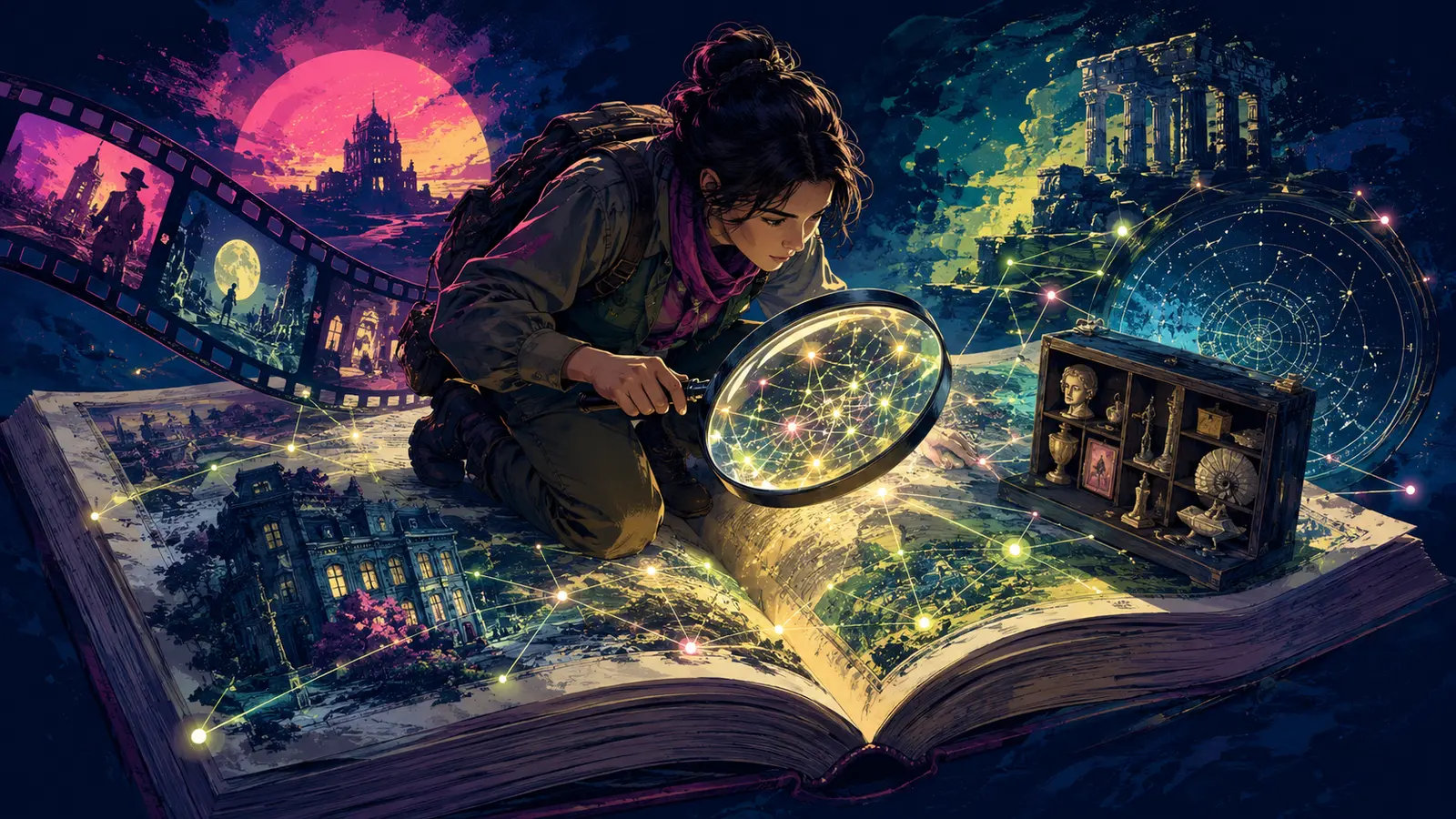
Curiosity-Driven Close Reading: A Framework for Noticing More
Most of us are very good at moving through things.
We finish the chapter. We clear the dungeon. We watch the episode. We walk through the building. We scroll past the photograph. We hear the name of a character and immediately continue to the next line of dialogue.
Curiosity-driven close reading begins by doing something almost embarrassingly simple:
Stop.
Notice the thing that made your mind hesitate.
Then ask why.
Traditional close reading is associated with careful attention to a written text. A reader examines word choice, imagery, structure, repetition, point of view, symbolism, and other details in order to understand how a work produces meaning.
Curiosity-driven close reading keeps that discipline of attention but expands its object.
A “text” can be a novel, but it can also be:
- a video game
- a film
- a painting
- a building
- a city
- a costume
- a song
- a ritual
- a user interface
- a political speech
- an advertisement
- a fictional weapon
- a monster design
- a menu screen
- a place name
- an ordinary object whose design makes you wonder why it looks the way it does
The goal is not to force every detail to contain a secret message.
The goal is to become unusually attentive, to follow interesting questions wherever they lead, and to return to the original object seeing more than you saw before.
A compact version of the method is:
Notice → Wonder → Investigate → Connect → Interpret → Revisit
That sequence is the heart of curiosity-driven close reading.
Why “curiosity-driven”?
Ordinary analysis often begins with an assignment.
Analyze the symbolism of water in this novel.
Or with a thesis.
This film is a critique of consumer capitalism.
The analyst then looks for relevant evidence.
Curiosity-driven close reading can work differently. It often begins before you know what the important question is.
You encounter something and think:
That’s strange.
Or:
Why does that name sound familiar?
Or:
Why did the designers make this room so enormous?
Or:
That musical phrase sounds almost religious. Is it?
Or simply:
I wonder what that’s about.
The question is allowed to precede the thesis.
This matters because curiosity can reveal questions you would never have thought to assign yourself in advance.
Instead of using research only to prove an existing argument, you allow research to change what you think the argument might be.
Why “close reading”?
The word reading should be understood broadly here.
To read something closely is to treat its details as worthy of attention.
A literary scholar might read a sentence.
An art historian might read a painting.
An architect might read a building.
A game scholar might read a combat mechanic, an environment, a map, or an interface.
A player might notice that a fictional city places wealthy citizens physically above poorer citizens and begin asking what that vertical geography communicates about social power.
The object need not consist of words.
The important habit is the same:
Do not rush past the detail merely because the larger work allows you to.
The framework
The following framework is intentionally flexible. Not every investigation needs every step, and the steps can loop backward.
Sometimes research creates a new observation. Sometimes an interpretation generates a better question. Sometimes the correct conclusion is that an apparent connection was probably accidental.
That is fine.
The purpose is disciplined curiosity, not forced certainty.
1. Notice
Everything begins with attention.
Ask:
What made me pause?
The answer might be something obviously important, but often it will be tiny.
You might notice:
- an unusual name
- a repeated color
- a peculiar costume
- a building shaped differently from everything around it
- an enemy whose design resembles a religious image
- an unexpected musical instrument
- a phrase that sounds archaic
- a symbol on a door
- a camera angle used repeatedly
- a gameplay mechanic that seems thematically appropriate
- a conspicuous absence
- a contradiction
- something that feels familiar even though you cannot place it
Do not worry yet about whether the detail is “important enough.”
Curiosity is the filter.
If your mind catches on it, write it down.
A useful practice: the curiosity ledger
Keep a running list while reading, playing, watching, or exploring.
For each item, record only enough to preserve the question.
For example:
| Observation | Immediate question |
|---|---|
| Character named Sephiroth | Where does that name come from? |
| City built on multiple vertical levels | Does height correspond to class or power? |
| Boss arena resembles a cathedral | Is the religious architecture meaningful? |
| Healing animation uses flowers | Why flowers rather than light or water? |
| NPC uses unusually formal speech | What does the register tell us about them? |
This prevents a common failure of curiosity: noticing something interesting and forgetting it thirty seconds later.
2. Wonder
Observation becomes inquiry when you turn it into a question.
Weak questions often ask only for identification:
What is this called?
That can be a useful beginning, but stronger questions ask about origin, purpose, relationship, or effect.
Try questions such as:
- Where does this come from?
- Why might this choice have been made?
- What does this resemble?
- What associations would this have for different audiences?
- Has this appeared elsewhere in the same work or series?
- How has it changed over time?
- What does this detail make me feel, and how might the design produce that effect?
- What cultural, historical, religious, artistic, or technological tradition might be relevant?
- Is this detail reinforcing the story, contradicting it, or doing something independent of it?
- If this detail were different, what would change?
A particularly powerful question is:
Why this instead of something else?
Why this name?
Why this architectural style?
Why this monster?
Why this color?
Why this mechanic?
Design requires choices. Comparing the chosen possibility with plausible alternatives can reveal what the choice accomplishes.
3. Investigate
Now follow the question outward.
This is the research stage.
Depending on the question, useful sources might include:
- dictionaries and etymological references
- mythology and religious studies
- history
- art history
- architectural history
- anthropology
- folklore
- philosophy
- interviews with creators
- developer commentary
- concept art
- game manuals
- production notes
- academic scholarship
- primary historical texts
- maps
- museum collections
- music theory
- linguistics
- fan documentation, used carefully and verified where possible
The key rule is:
Research should enlarge the question, not merely decorate the answer.
Suppose a game contains a weapon called Balmung.
A superficial investigation might stop after learning that Balmung is a legendary sword associated with the Germanic heroic tradition.
A deeper investigation might ask:
- Which texts use the name?
- Is Balmung identical to, related to, or sometimes conflated with other legendary swords?
- What kind of hero is associated with it?
- What themes surround that hero?
- Does the game preserve any of those associations, or borrow only the prestige of the name?
- Has the name appeared elsewhere in the franchise?
The point is not to make every rabbit hole infinite.
It is to notice when a fact opens a more interesting door.
4. Connect
Research produces fragments. Analysis begins when you connect them.
Ask:
How does what I learned change my understanding of the thing I originally noticed?
Connections can occur at several levels.
Connection within the work
Does the detail connect to other scenes, characters, mechanics, or symbols?
Connection across a series
Does the same name, creature, spell, musical motif, or visual design recur in other entries?
Connection to culture or history
Does the work draw on mythology, religion, architecture, politics, philosophy, folklore, or historical events?
Connection across media
Does a game borrow cinematic language? Does a film frame a character like a religious icon? Does a fantasy city resemble the industrial landscapes of a particular historical period?
Connection to the audience
What knowledge is assumed?
A reference obvious to one cultural audience may be obscure to another.
A Japanese player, an American player, an Indian player, and a scholar of comparative religion may notice very different things in exactly the same scene.
Those differences can themselves become part of the analysis.
5. Interpret
Now ask what the connections might mean.
Interpretation differs from identification.
Identification says:
This character’s name derives from X.
Interpretation asks:
What happens when the work gives this character that name?
A useful interpretation should usually contain three parts:
- Observation — what is actually there.
- Context — what relevant research tells us.
- Claim — what the relationship may help us understand.
For example:
The city repeatedly places political and economic elites in physically elevated spaces while laborers occupy lower industrial districts. Because the game’s plot also emphasizes unequal access to resources, the city’s vertical architecture turns class hierarchy into something the player literally navigates.
That is stronger than saying:
The upper city symbolizes rich people.
The first explanation shows how several forms of evidence work together.
Interpretations have confidence levels
Curiosity-driven close reading should make room for uncertainty.
Not every resemblance proves intention.
It helps to distinguish among claims such as:
Documented
A creator explicitly explains the connection.
Strongly supported
Multiple details make the interpretation persuasive even without direct confirmation.
Plausible
The connection fits the evidence but alternatives remain equally reasonable.
Speculative
The resemblance is interesting but evidence for intentional connection is weak.
This prevents one of the most common analytical mistakes:
“I found a similarity, therefore the creator definitely intended it.”
Sometimes the best sentence in an analysis is:
“We cannot know whether this was intentional, but the comparison is still illuminating.”
Interpretive usefulness and authorial intention are related, but they are not identical.
6. Revisit
Return to the original object.
This step is easy to skip and may be the most important.
After investigating the mythology behind a character’s name, look at the character again.
After learning about the architecture that inspired a city, walk through the city again.
After studying the religious tradition behind a visual motif, replay the scene.
Ask:
What can I see now that I could not see before?
This completes the transformation:
familiar → strange → investigated → newly familiar
The object has not changed.
Your perception has.
That transformation is one of the great pleasures of close reading.
7. Generate the next question
Good investigation rarely ends with a period.
It creates another question.
You discover that a monster’s name comes from mythology.
That mythology contains an unusual cosmology.
The game’s world happens to contain a similar cosmological structure.
Now you have a new question.
Curiosity-driven close reading is therefore better represented as a loop:
Notice → Wonder → Investigate → Connect → Interpret → Revisit → Notice again
The purpose is not to arrive at a final explanation of the work.
It is to develop increasingly rich ways of seeing it.
Example 1: A mythological name in Final Fantasy
Imagine encountering a character named Sephiroth in Final Fantasy VII without knowing where the name comes from.
Notice
“Sephiroth” is an unusual name. It sounds invented, but perhaps not arbitrarily invented.
Wonder
Where does the name come from?
Investigate
Research leads toward sefirot, a term associated with Jewish Kabbalistic traditions and the structure commonly represented through the Tree of Life.
That immediately creates additional questions:
- Why draw from this tradition?
- Are other names or images in the game related to it?
- Is the reference theological, symbolic, aesthetic, or primarily evocative?
- How accurately does the game use the source tradition?
Connect
You compare the historical and religious material with the game’s imagery, character relationships, cosmology, and other names.
You may discover strong connections, weak connections, or cases where the game freely recombines imagery from unrelated traditions.
Interpret
Instead of concluding merely that “Sephiroth is a Kabbalah reference,” you can ask what the borrowed language contributes.
Perhaps it gives the character an aura of cosmological significance. Perhaps it participates in a larger pattern of the game using religious vocabulary to make technological and planetary events feel sacred or apocalyptic.
The exact interpretation must be supported by the game’s other evidence.
Revisit
Now replay scenes involving the character.
Do particular images, names, or relationships stand out differently?
The research has changed the game you are seeing.
Example 2: Reading architecture
Suppose you enter a fictional capital city dominated by monumental stone buildings, enormous staircases, military banners, and plazas designed to make individual people appear tiny.
Notice
The architecture seems excessive compared with ordinary human scale.
Wonder
Why make government buildings so large?
Investigate
You might research:
- monumental architecture
- imperial capitals
- fascist architecture
- neoclassicism
- palace complexes
- procession routes
- architecture as political communication
Connect
You notice that the game’s government also presents itself as eternal, orderly, and superior to the individual.
The spatial design may reinforce those political ideas before a character ever explains them in dialogue.
Interpret
The architecture is not merely a background behind the story.
It is participating in the story’s argument about power.
The player experiences authority spatially by being made small.
That is something a plot summary would miss almost completely.
Example 3: Reading a character design
Imagine a character who wears immaculate white clothing in a world where nearly everyone else wears practical, dirty, earth-toned clothing.
Notice
The character visually does not belong.
Wonder
Why white?
Investigate
Possible avenues include:
- local cultural meanings of white
- purity symbolism
- mourning traditions
- medical clothing
- priestly clothing
- military uniforms
- visual contrast and character readability
- the design history revealed by concept art
Importantly, color symbolism varies across cultures. White does not mean exactly the same thing everywhere.
Connect
Perhaps the character claims moral purity while committing terrible acts.
Perhaps they remain physically untouched by the dirt surrounding everyone else.
Perhaps their clothing resembles a ceremonial or religious garment.
Interpret
The costume may communicate separation, sanctity, sterility, hypocrisy, privilege, death, or several things at once.
The correct interpretation depends on evidence.
The useful habit is not memorizing “white = purity.”
It is asking:
Why does this work put this character in white here?
Example 4: Reading a gameplay mechanic
Curiosity-driven close reading becomes especially interesting with games because games contain meaning that does not exist only in dialogue or images.
Suppose a game tells you that a character is becoming dangerously powerful.
Later, the game’s combat system gives that character abilities that trivialize encounters.
Notice
The mechanics themselves feel different.
Wonder
Is the imbalance intentional?
Investigate
You might compare:
- the character’s statistics before and after the story event
- developer interviews
- other characters’ mechanical growth
- how long the imbalance lasts
- whether the player is encouraged to enjoy or fear the power
Connect
The narrative tells you the character has become extraordinary, but the combat system also makes you experience that extraordinariness.
Interpret
The mechanic does not merely represent the story.
It recruits the player into it.
Instead of being told “this person is overwhelmingly powerful,” you briefly inhabit that power.
This is a kind of meaning that literary analysis alone may not capture well.
Example 5: Reading a mundane object
The method need not be limited to art.
Suppose you notice that many older public buildings have enormous staircases leading to their main entrances.
Notice
Why so many stairs?
Wonder
Were they practical, aesthetic, symbolic, or all three?
Investigate
You research architectural styles, flood control, ceremonial entrances, classical architecture, civic symbolism, accessibility standards, and building technology.
Connect
You may discover that what looked like decoration also communicated dignity, separated public institutions from street life, created ceremonial movement, and reflected assumptions about who could physically access the building.
Revisit
The next time you encounter a courthouse, museum, capitol, or university building, the staircase is no longer just a staircase.
This illustrates a larger principle:
Curiosity-driven close reading is really a method for becoming more attentive to the designed world.
A question bank for games
When playing a game slowly, the following questions can generate investigations.
Names and language
- Where does this character’s name come from?
- Is the name historical, mythological, linguistic, or invented?
- Why does this region use one naming convention while another region uses a different one?
- Are accents or speech registers being used to signal class, geography, education, or age?
Character design
- Why these colors?
- Why this silhouette?
- What historical clothing does this resemble?
- What does the costume tell us before the character speaks?
- How does the design change over time?
Architecture and environment
- What real architectural traditions does this place resemble?
- How does space express hierarchy?
- Who lives above, below, inside, outside, near the center, or at the edge?
- What infrastructure exists?
- What is strangely missing?
- Does the environment make the player feel safe, insignificant, trapped, powerful, or watched?
Monsters and creatures
- Does the creature come from mythology or folklore?
- How has the source creature been transformed?
- Why is it located here?
- Does its design fit the area’s themes?
Religion and mythology
- Which traditions are being referenced?
- Are references combined from unrelated traditions?
- Is the game borrowing theology, imagery, vocabulary, or simply an evocative name?
- How might someone from the source tradition read this differently?
Mechanics
- What behavior does the game reward?
- What behavior does it punish?
- Does gameplay reinforce or contradict the story?
- What does the player repeatedly have to do?
- What assumptions about power, scarcity, violence, cooperation, or progress are embedded in the rules?
Music and sound
- What instruments are being used?
- Is the music borrowing from a recognizable tradition?
- Why does this character have this motif?
- When does the motif return?
- What sounds are absent?
Interfaces
- What information does the game consider important enough to display constantly?
- What is hidden?
- What visual metaphors does the interface use?
- Does the UI belong aesthetically to the fictional world or sit outside it?
Story and structure
- Whose perspective dominates?
- Who never gets to speak?
- What events happen off-screen?
- Which conflicts can the player influence and which are predetermined?
- What does the story treat as a good ending?
Beware the reference-hunting trap
Once you begin noticing references, everything can start looking like a reference.
This can become a kind of intellectual pareidolia.
A character resembles a mythological figure, therefore they must be based on that figure.
A building has a dome, therefore it must reference a particular cathedral.
Two symbols look vaguely alike, therefore they must share an origin.
Curiosity-driven close reading should resist this temptation.
Ask:
- What evidence supports the connection?
- Are there simpler explanations?
- Is this motif widespread across many cultures?
- Could both works draw from an older common source?
- Could the similarity be accidental?
- Am I seeing what I expected to see after beginning the research?
The goal is not to maximize the number of hidden references discovered.
The goal is to understand the object better.
Beware the intention trap
Another common mistake is assuming that analysis is valuable only if we can prove what the creator consciously intended.
Creator intent matters enormously when it is documented.
But cultural works can produce meanings their creators did not explicitly plan.
A designer inherits conventions.
A writer uses metaphors embedded in a language.
An artist absorbs visual traditions.
A game system produces consequences nobody anticipated.
Audiences bring knowledge and experiences the creator may not share.
So there are at least two separate questions:
What did the creator appear to intend?
and
What meanings become visible when we examine the work carefully?
Do not confuse them, but do not assume only the first is legitimate.
Beware the single-culture lens
A symbol does not have one universal meaning.
Stories, colors, animals, numbers, religious images, family roles, concepts of heroism, and even ideas about what a story is for vary across traditions.
Curiosity-driven close reading becomes much stronger when it asks:
From whose cultural perspective does this interpretation make sense?
For example, an individualistic reading might interpret a character’s refusal of family obligations as liberation.
Another tradition might interpret the same action primarily through duty, kinship, ancestry, or social harmony.
Neither perspective should automatically be treated as the universal default.
Comparative interpretation often reveals assumptions that remain invisible when we inhabit only one framework.
The method should preserve wonder
Analysis has a bad reputation in some circles because people fear that explaining art destroys its magic.
Sometimes poor analysis does.
It takes a beautiful thing and reduces it to a vocabulary word:
“The blue curtain represents sadness.”
Curiosity-driven close reading should do the opposite.
A good investigation makes the object larger.
A sword becomes connected to centuries of legend.
A city becomes connected to political history and architectural theory.
A melody becomes connected to ritual, instrumentation, and recurring character motifs.
A monster becomes connected to the migration of folklore across languages and cultures.
The goal is not to explain the mystery away.
It is to discover how much more mystery was hiding inside something you almost walked past.
Curiosity-driven close reading as a content format
The method naturally lends itself to essays, podcasts, streams, or videos.
A particularly interesting format is to let the audience watch the inquiry unfold.
Instead of beginning every episode with a polished thesis, begin with the moment of curiosity:
“I stopped here because this name is strange. I want to know where it comes from.”
Then show the intellectual movement:
- what you noticed
- what you initially guessed
- what you researched
- where your guess was wrong
- what unexpected connections appeared
- what interpretation now seems plausible
- how the original scene looks different afterward
This makes the formation of understanding part of the content.
Most educational material presents knowledge after uncertainty has been removed.
Curiosity-driven content can show something equally valuable:
what it looks like to become less ignorant in real time.
That includes false starts, revisions, ambiguity, and genuine surprise.
Slow consumption can be a feature
Modern media often rewards speed.
Finish the game.
Reach the ending.
Watch the recap.
Read the summary.
Skip the dialogue.
Search for the optimal build.
Curiosity-driven close reading proposes a different objective:
The purpose is not to get through the work. The purpose is to let the work provoke thought.
A two-minute walk through a game environment might produce an hour of investigation.
That is not inefficiency if investigation is the point.
One could think of this as a kind of slow gaming, analogous to slow reading or slow travel.
Progress is measured not by how much content has been consumed but by how much has been noticed.
Artificial intelligence and curiosity
AI creates an interesting tension for this practice.
It can help tremendously with investigation:
- generating search terms
- explaining unfamiliar concepts
- comparing possible interpretations
- translating terminology
- identifying disciplines that might contain relevant knowledge
- helping organize notes
- challenging an argument
But AI can also short-circuit the most valuable part of the process.
There is an enormous difference between asking:
“Give me an analysis of this scene.”
and saying:
“Something about this scene bothers me. I think it may have to do with the architecture. Help me figure out what questions I should investigate.”
In the first case, the machine can become a substitute for wondering.
In the second, it becomes an instrument for pursuing wonder.
A useful rule is:
Outsource retrieval before you outsource curiosity.
Let tools help you find information.
But try to preserve the moment when you notice something and ask:
Why?
That moment is intellectually precious.
Imagination is part of analysis
Analysis is sometimes portrayed as the opposite of imagination.
It is not.
Interpretation requires imagining alternatives.
Why did the designer choose this building instead of another?
How would the scene feel with different music?
What would change if the story were told by another character?
What assumptions am I importing from my own culture?
What might a completely different reader notice?
What possible histories could explain this object?
These are acts of disciplined imagination.
Good analysis does not merely classify what already exists.
It creates possible explanations and tests them against evidence.
The deepest goal: become a person who notices
The framework can produce interesting essays and videos, but that may not be its most important use.
Practiced long enough, curiosity-driven close reading changes your relationship with ordinary experience.
You begin noticing names on buildings.
Street layouts.
Typography.
Why restaurants arrange tables the way they do.
Why software uses particular metaphors.
Why a government form asks one question before another.
Why an old neighborhood looks different from a new one.
Why a piece of machinery has a strange shape.
Why a story from another culture feels structurally unfamiliar.
The world becomes covered in handles for thought.
This is perhaps the central principle of curiosity-driven close reading:
Interesting things are not rare. Attention is.
The method is therefore not merely a way to analyze media.
It is a practice of deliberately resisting the urge to pass through the world without examining it.
Notice.
Wonder.
Investigate.
Connect.
Interpret.
Return.
Then notice something else.