What We Hire YouTube to Do
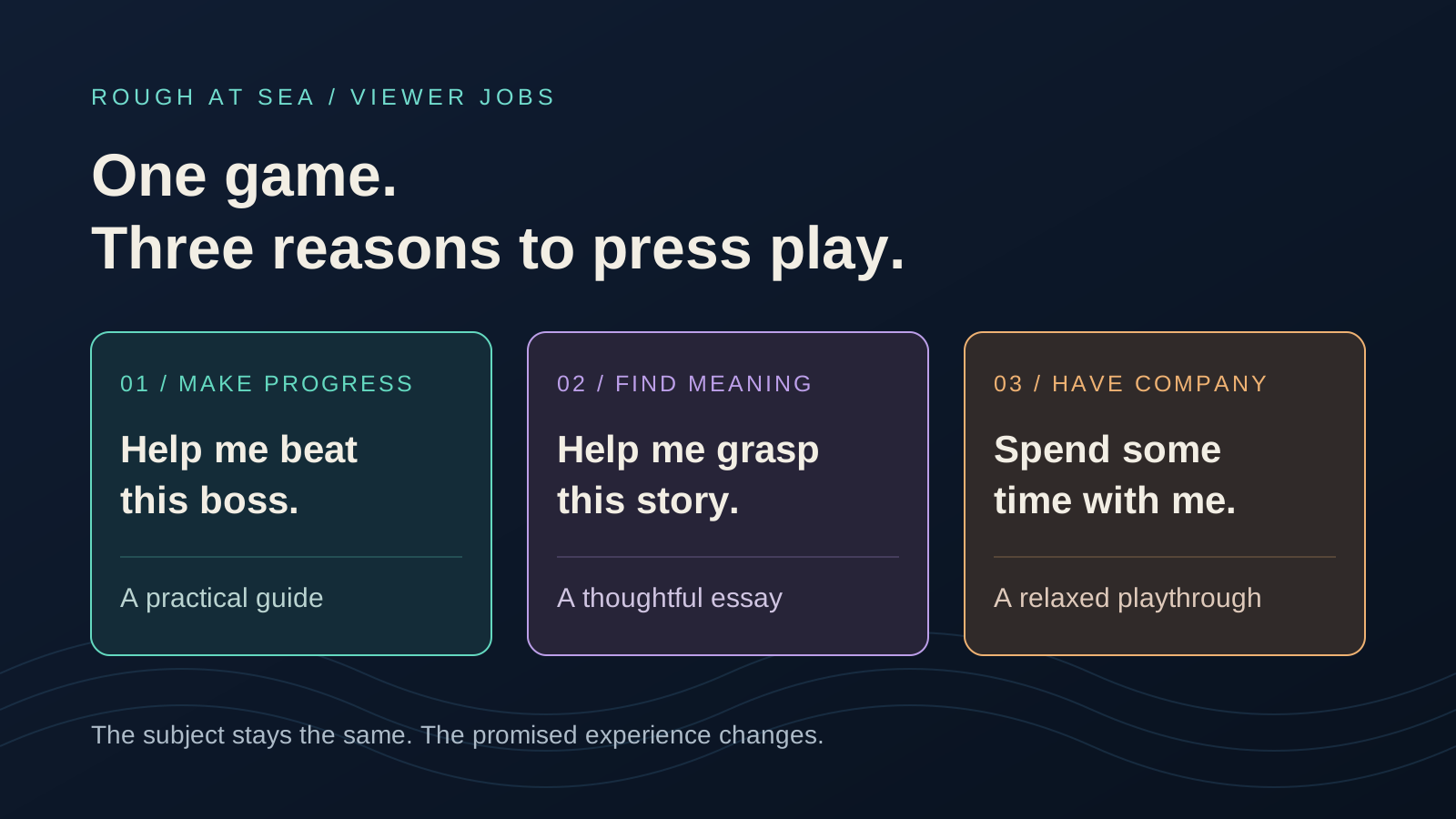
Imagine opening a video because you cannot beat a boss in a game. The title promises help. The creator begins with the history of the franchise, moves into childhood memories, and explains why the boss represents the protagonist’s unresolved grief. Four minutes pass. You still do not know when to dodge.
Now imagine finding the same analysis after finishing the game. You have been thinking about its ending all day. The creator notices something you missed, then gives words to a feeling you could not quite explain. This time, four minutes seems too short.
These are hypothetical viewing situations, but they expose a real problem for creators: the quality of a video depends partly on what someone came to it for. Research, editing, and enthusiasm cannot settle that question by themselves. A beautifully made video can arrive at the wrong moment with the wrong offer.
The business framework called Jobs to Be Done provides a useful way to examine that mismatch. Applied carefully, it can help a YouTuber choose a premise, shape an episode, and interpret disappointing results. Applied carelessly, it can become another story in which success proves the theory and failure is always the creator’s fault.
1. The job begins before the click
The Christensen Institute describes a job as the progress someone seeks in particular circumstances. People “hire” products or services to help them make that progress. Functional, emotional, and social needs can all influence the choice. The framework asks us to examine the situation that produces demand, beyond the customer’s demographic category or the product’s features. Christensen Institute: Jobs to Be Done.
On YouTube, the hiring metaphor involves spending attention and time. A viewer may want to repair something, feel less alone during dinner, understand an argument, or briefly escape the obligation to be useful. Leisure counts. A video does not need to improve its viewer to have done something valuable.
“People who like games” describes an interest. “Someone who has twenty minutes before friends arrive and wants to understand the rules well enough to join them” describes a circumstance with an outcome. The second description starts making editorial decisions: explain the first moves, show what a turn looks like, and postpone obscure exceptions.
It also identifies competition. That viewer could read a quick-start sheet or ask a friend. Someone seeking company could choose a podcast or call a sibling. Under this analysis, a creator competes with whatever else could accomplish the same purpose, including activities outside YouTube.
There is no official, exhaustive list of video jobs. The following is a practical adaptation of the framework, with imagined requests rather than quotations from audience research.
| Viewer job | The request behind it |
|---|---|
| Stay informed | Tell me what happened and what I need to know. |
| Understand | Make something confusing finally make sense. |
| Do or fix something | Help me complete this task or acquire this skill. |
| Decide | Help me choose what to buy, play, use, or investigate. |
| Discover | Find worthwhile things I would not have found myself. |
| Enjoy an experience | Make the next twenty minutes funny, surprising, suspenseful, or absorbing. |
| Change a mood | Help me settle down, feel wonder, revisit a comforting memory, or release an emotion. |
| Have company | Be a welcome presence while I eat, work, or rest. |
| Belong or feel recognized | Let me participate in a shared interest or hear an experience like mine articulated. |
| Find encouragement | Show me a possibility I can imagine pursuing. |
| Appreciate more deeply | Reveal something I missed in a work I already care about. |
The categories overlap. An explanation can be funny; a tutorial can restore confidence; criticism can provide both insight and belonging. Choosing a primary job helps resolve conflicts between those purposes. When a joke delays a necessary instruction, or a plot summary crowds out interpretation, the creator has a basis for deciding what to cut.
2. One subject can contain incompatible promises
Consider three possible videos about the same role-playing game.
A boss guide serves a player who is stuck. It needs recognizable attacks, specific responses, prerequisites, and a demonstration that works. Chapters may let viewers skip directly to the move that kills them. A quick departure after the answer could be entirely compatible with a useful video.
An essay about the ending serves a different moment. Its viewer may want a thoughtful interpretation, evidence from scenes, and room to reconsider a character. Here, revealing the conclusion immediately and stripping away every digression might weaken the experience. The development of the argument is part of what the viewer came for.
A relaxed playthrough may offer company. The host’s reactions, continuity, and conversational rhythm could matter more than efficient progress. Editing away every pause might remove the very presence the audience enjoys.
These are editorial hypotheses, not rules for every person watching those formats. Their value is that they make competing choices visible. There is no universal answer to how much personality, speed, explanation, or polish a video needs.
A common source of disappointment would be to advertise one of these experiences and deliver another. A title promising an explanation of a difficult ending creates an expectation that a chronological plot recap may never fulfill. A tutorial that spends its opening establishing the creator’s personal journey can frustrate a viewer who arrived with an urgent technical problem.
Before recording, a creator can write a simple sentence: When this situation arises, this viewer wants this outcome. Then inspect the title, opening, structure, and ending against that sentence. A promise that cannot be found in the finished video needs revision, however strong the individual scenes may be.
3. Being chosen, being useful, and being chosen again
For this article, it helps to separate three events: someone chooses a video, finds the experience worthwhile, and later chooses another video from the same creator. These events can support one another, but none guarantees the next.
A clear title can communicate an appealing outcome. The opening can establish that the creator understands the viewer’s situation. The body must then do the promised work. A channel earns a further opportunity when the viewer has a reason to expect something worthwhile from another episode.
YouTube says its recommendation system aims to help people find videos they want and maximize long-term viewer satisfaction. Its published explanation describes signals including watching behavior, feedback, and survey responses. That supports taking the viewer’s experience seriously; it does not establish that Jobs to Be Done is YouTube’s internal model or provide a formula for distribution. YouTube: Recommendation System.
The distinction becomes especially useful with tutorials. YouTube explicitly notes that viewers of how-to channels may get their answer and never return. That can reflect interest in an individual question rather than the channel’s overall offering. YouTube: New, casual, and regular viewers.
A repair channel could therefore publish a valuable library while attracting relatively little repeat viewing from any one person. New people keep encountering old problems. The relevant business question would be whether that continuing demand supports the cost of maintaining the library. A personality-led series would face a different question: does the audience want another encounter with this host?
Neither model is inherently superior. Trouble begins when a creator builds one and measures it as though it were the other. Someone who fixed a dishwasher does not owe the instructor a weekly relationship.
4. How the framework can explain failure—and misdiagnose it
Jobs to Be Done is most useful when it produces a specific explanation that can be investigated. “People did not want it” is too elastic to teach anything. Several more precise failure patterns follow from the examples so far.
The offer is difficult to recognize. A capable video may have a title that names its subject without making its value apparent. “Thoughts on inventory systems” leaves much more work to the prospective viewer than a clearly supported question about why managing a backpack becomes tedious in a particular game. The appropriate revision depends on the actual episode; a stronger promise creates a greater obligation to deliver.
The video attracts the wrong expectation. A sensational title can invite curiosity that the body cannot satisfy. The immediate problem is the distance between the promise and the experience. Rewriting the opening cannot rescue a promise the evidence does not support.
The creator improves an attribute the viewer scarcely needs. More elaborate animation will not necessarily help someone identify the correct replacement part. A sharper camera may add little to a conversation someone primarily listens to. Production improvements should address an obstacle to the intended experience, with their cost justified accordingly.
An isolated hit does not supply a repeatable reason to watch. Imagine a programming channel whose unusual video about a game’s ending becomes popular. Following it with a routine framework tutorial may disappoint the new viewers. Both videos can be good; the connection between their intended audiences remains unproven. A bridge episode might examine a story question through a tool the creator builds, making the shared interest visible.
The desired job has insufficient reachable demand. A premise can be clear and well executed while serving a small audience, facing excellent substitutes, or being expensive to produce. Someone else may already perform the job with a reputation a newcomer has not earned. Knowing the job helps specify the challenge; it does not make the challenge disappear.
Low views alone cannot tell a creator which explanation applies. Nor do they establish poor quality. Exposure, topic demand, competition, timing, and chance can complicate the outcome. YouTube’s account of recommendations itself acknowledges influences beyond a video’s performance and personalization. YouTube: Recommendation System.
The framework also has a more subtle weakness: it can describe any success after the fact. If a strange, unexpectedly popular video succeeds, it is easy to announce that viewers hired it for surprise or belonging. Unless that interpretation produces a useful prediction or matches evidence about actual viewing circumstances, it adds a label without adding understanding.
5. Read analytics as clues to an experience
YouTube Analytics can help a creator investigate these possibilities, but a metric records behavior through a particular measurement system. It cannot fully report the purpose of a human being.
Thumbnail click-through rate measures how often registered thumbnail impressions lead to watching. Not every source of a view produces a counted impression. A percentage therefore needs context: where the offer appeared and whom it reached. YouTube: Thumbnail impressions and watch time.
Audience retention shows where people continue watching, skip, leave, or revisit a passage. YouTube notes that a spike may reflect either interest or confusion that prompted rewatching. Its guidance on the opening also connects retention with whether the video meets expectations created by the title and thumbnail. YouTube: Audience retention.
The following interpretations are hypotheses to investigate, not diagnoses supplied by YouTube.
| Observation | A useful question |
|---|---|
| Few clicks from a meaningful set of relevant impressions | Does the offer make the intended benefit clear? Were these actually the people it serves? |
| Many clicks, then an early departure | Does the opening begin the promised experience, or delay it? |
| A sharp exit after a tutorial’s answer | Did the viewer finish the task, or find the explanation inadequate? |
| A repeatedly watched passage | Was that moment valuable enough to revisit, or difficult to understand? |
| A popular video with little subsequent viewing | Is the need occasional, or does the next episode fail to offer a relevant continuation? |
Comments and conversations can help distinguish the possibilities, although people who respond are a self-selected group. Ask about a recent viewing occasion: What was happening just before you opened YouTube? What did you hope the video would do? What else did you consider? Where did you stop, and why? What happened afterward?
That last question is particularly useful for instruction. A viewer who closes the video and successfully completes a task has accomplished something a retention chart alone cannot confirm. Conversely, a long viewing session may end without understanding or satisfaction. Treat the numbers and the viewer’s account as partial evidence that can correct each other.
6. Choose a promise you can afford to keep
For a new creator, choosing a job should involve both the audience’s circumstances and the creator’s ability to deliver repeatedly. Five questions make that choice concrete:
- Who encounters this need, and when? Describe an occasion, not just an interest or age group.
- What do they use now? Include other creators, written material, friends, and doing nothing.
- What can this channel contribute? Look for demonstrable expertise, access, judgment, explanation, or a distinctive experience.
- What makes another episode worth watching? The answer might be a recurring need, a new mystery, a continuing project, or an enjoyable host.
- Can the creator sustain the cost? Account for research, recording, editing, corrections, and the effect on the rest of life.
An analytical creator who enjoys both software and stories might test a promise such as helping players understand how games create their effects. Episodes could investigate a narrative puzzle, compare two design choices, or build a small simulation that makes an invisible system visible. Those formats have a plausible shared purpose. Whether they attract the same people remains something to learn.
A practical first experiment could be a small batch of three to six videos serving that purpose. This is a manageable learning exercise, not a statistically validated threshold. Write the intended viewer situation for each episode before production. Keep enough of the format consistent to make comparisons useful, then examine differences in topic, presentation, and response. Compare videos at similar ages and consider their traffic sources and lengths rather than treating a raw ranking as a verdict.
State in advance what would change the plan. If viewers consistently praise the explanation but report difficulty following the visuals, improve the demonstration. If an episode attracts people for a purpose absent from the planned series, decide whether to serve that purpose again. If production takes so long that a promising format is untenable, simplify it or choose a different offer.
Success also needs a definition beyond views. A teaching channel might seek reliable educational outcomes; an essayist might value a returning readership; a business might seek customers; a hobbyist might want creative satisfaction and a modest community. Viewer value and creator value must meet somewhere. A large audience can still leave its creator exhausted or unable to cover costs. A small audience can be sufficient for a carefully chosen goal.
7. Leave room for something the viewer could not request
There is a reasonable objection to all this talk of hiring: art can sound diminished when described as a service transaction. A creator may discover something worth making before anyone has asked for it. An essay can change a viewer’s question. An unfamiliar style can teach its audience how to enjoy it.
Jobs to Be Done should leave those possibilities intact. Its strongest contribution here is to make the creator curious about the life surrounding the click. That curiosity can improve the invitation without requiring the work to obey every expressed preference. It can also reveal when a commercially attractive desire—such as constant reassurance that the viewer’s side is right—conflicts with the creator’s standards.
Return to the player waiting to learn when to dodge. A creator could postpone the instruction, hoping the player will stay longer. Or the creator could show the move clearly, let the player get back to the game, and make a separate essay for the evening when the ending will not leave that player alone.
The second choice gives each video a purpose someone can recognize. It also accepts that doing the work well sometimes means helping the viewer close the tab.