The Daily Reckoning
Why Is There No Quintic Formula?
Equations of degree five exposed a limit of algebraic formulas—and turned the permutations of roots into a new kind of mathematics.
- Difficulty
- Advanced
- Area
- Numbers and algebra
- Reading time
- 10 minutes
- Prerequisites
- The quadratic formula · Square roots and nested radicals · Composition of reversible operations
The quadratic formula solves every equation
using the coefficients , , and , the four arithmetic operations, and a square root. Mathematicians eventually found longer formulas for cubic and quartic equations. A natural pattern seems to be forming: work harder, accept a more elaborate nest of roots, and solve the next degree.
Then degree five refuses.
There is no formula built from addition, subtraction, multiplication, division, and roots that solves every quintic equation
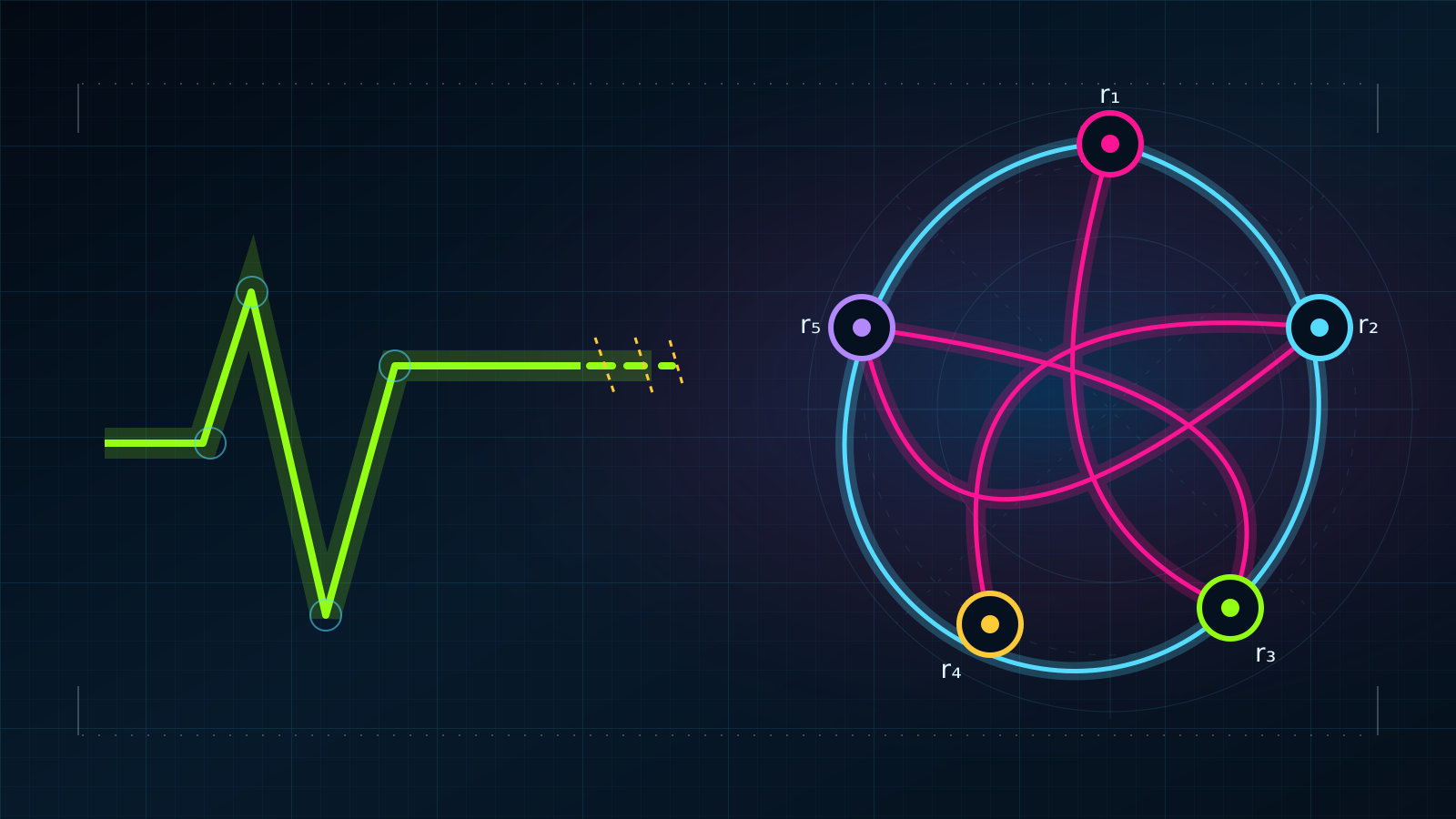
The obstruction is not a shortage of ingenuity. The general quintic contains root symmetries that no finite tower of radicals can reproduce.
What “no formula” means
A radical expression starts with a polynomial’s coefficients and applies the four arithmetic operations together with th roots such as , , and . Nested roots are allowed. The quadratic formula is a radical expression because
uses only those operations.
The Abel–Ruffini theorem says that no radical expression solves the general polynomial of degree five or higher. The word general matters. Some particular quintics are easy: has the real solution , and all five complex roots can also be written with radicals. The theorem says that one radical recipe cannot accept arbitrary quintic coefficients and return their roots.
Niels Henrik Abel proved that impossibility. Évariste Galois found a sharper question: given one particular polynomial, what property decides whether its roots can be written with radicals?
Stop staring at the formula; watch the roots move
Consider the quartic equation
Its four roots are
Changing the sign of swaps the roots in pairs. Changing the sign of makes a different pair of swaps. Neither change alters any rational number, and both changes respect addition and multiplication.
The interactive number line below keeps the four root positions fixed. Each colored token starts on one root. Use either sign-flip button to send every token to the root obtained by changing that square-root sign.
ROOT-SYMMETRY WORKBENCH
Permute the roots without breaking their algebra
x4 − 10x2 + 1 = 0
Press the two sign flips in either order. Both routes produce the same final permutation. These symmetries commute: applying transformation and then transformation gives the same result as applying and then .
The four possible operations—flip neither sign, flip only , flip only , or flip both—form a group. A group is a collection of reversible operations that can be composed associatively, contains a do-nothing operation, and stays inside the collection when operations are combined. Here, every operation is its own inverse because performing the same sign flip twice restores the original signs.
The precise bridge from roots to groups
Let be a polynomial whose coefficients are rational numbers. Write for the smallest number system containing the rational numbers and every root of . Mathematicians call the splitting field of over the rational numbers.
The Galois group
is the group of all reversible maps from to itself that preserve addition, preserve multiplication, and leave every rational number fixed. The symbol denotes the rational numbers. Because each map preserves polynomial arithmetic, it must send a root of to another root of . The maps therefore act as permutations of the roots.
Galois theory gives the exact criterion:
A polynomial over the rational numbers can be solved by radicals if and only if its Galois group is a solvable group.
“Solvable” has a technical meaning here. A finite group is solvable when there is a chain
in which every is a normal subgroup of , and every quotient group is abelian. The symbol is the do-nothing operation. A subgroup is normal when it is stable under conjugation by operations in the larger group; a group is abelian when its operations commute. In less compressed language, a solvable group can be dismantled into layers whose remaining operations commute.
Taking an th root adds a controlled, cyclic layer of symmetry. A finite tower of radical operations can therefore build only a solvable symmetry group. The quartic in the interactive diagram has four commuting symmetries, so its group is already abelian and hence solvable.
The general quintic, whose coefficients are independent symbols, has the full symmetric group : all permutations of five roots are possible. Inside sits the alternating group , made from the even permutations. The group is non-abelian and has no nontrivial proper normal subgroup. That indivisible, noncommuting layer prevents from being solvable. Radical formulas cannot encode it.
This paragraph is a window into the proof, not the entire proof of the Abel–Ruffini theorem. A full proof constructs the correspondence between intermediate number systems and subgroups, then proves exactly how adjoining radicals changes the group. James Milne’s freely available Fields and Galois Theory supplies that machinery and proves the radical criterion.
Worked example: expose the quartic’s radicals
Solve
without using a memorized quartic formula.
Only even powers of appear, so define . The quartic becomes a quadratic:
Apply the quadratic formula:
The two values are perfect squares inside the number system containing and :
and
Because , each value of gives two signs for :
Those are exactly the four roots in the diagram. The calculation also explains why independently changing the signs of and permutes the roots without creating a new number outside the same system.
Try two checks
Problem 1
Verify directly that satisfies .
Reveal the solution
First square the proposed root:
Square once more:
Now substitute both powers:
Therefore is a root.
Problem 2
In the interactive diagram, start with . Flip the sign of , then flip the sign of . Where does land? What happens if the two flips are reversed?
Reveal the solution
Flipping first gives
Flipping next gives
Reverse the order. Flipping first gives
and flipping next again gives
The two operations commute, so both orders send to .
Several discoveries, one violent political life
The failure of a general quintic formula was not Galois’ discovery alone. Paolo Ruffini published an attempted impossibility proof in 1799; later mathematicians found gaps, although Ruffini had identified much of the right terrain. Abel produced a rigorous proof in 1824. The National Academies’ historical account describes how Abel’s argument closed the search for a universal radical formula.
Galois changed the question during the final years of the Bourbon Restoration and the first years of Louis-Philippe’s July Monarchy. The University of St Andrews’ biography of Galois records that he was an ardent republican, tried twice to enter the politically active École Polytechnique, and was locked inside the École Normale while students elsewhere joined the July Revolution of 1830. A newspaper attack on the school’s director led to Galois’ expulsion. He joined a republican artillery unit of the National Guard; the monarchy abolished that unit, and Galois was later arrested twice and imprisoned.
Political institutions constrained Galois’ life, while scientific institutions controlled the route his mathematics took toward publication. A memoir sent to the Paris Academy in 1830 disappeared after Fourier, the Academy’s secretary, died. Poisson rejected a later version as insufficiently developed while Galois was in prison. Galois died in 1832 after a duel whose cause remains disputed. The popular story that he invented group theory in one frantic night before the duel is exaggerated; he had developed and submitted the central ideas earlier. Joseph Liouville recognized the work in 1843 and published Galois’ papers in 1846.
Politics did not cause the radical criterion. Political commitments, institutional rejection, imprisonment, and an early death did affect Galois’ opportunity to explain the criterion and see it accepted.
Where the descendants operate
Computer algebra. Software can compute information about a polynomial’s Galois group and use the group to decide whether a radical solution exists. The answer can be “no” before a program wastes time searching for a formula that cannot exist. The algorithmic problem is tractable enough that Susan Landau’s work on solvability by radicals gives a polynomial-time decision method over the rational numbers.
Error-correcting codes. Finite fields are number systems with finitely many elements; they are also called Galois fields. Reed–Solomon codes evaluate and reconstruct polynomials over finite fields so that damaged data can be recovered. The National Aeronautics and Space Administration’s Reed–Solomon tutorial develops the field arithmetic used by the encoder and decoder. The application belongs to the field-theoretic descendants of Galois’ work, although it does not solve quintic equations.
Encryption. The Advanced Encryption Standard (AES) treats every byte as one of the elements of the finite field , where the letters abbreviate Galois field. The National Institute of Standards and Technology specification defines byte multiplication and multiplicative inverses in that field. AES uses finite-field structure for exact, reversible transformations; again, the connection is the algebra of fields rather than a hidden quintic formula.
One idea to remember
The quintic did not defeat algebra. It forced algebra to change its object of attention. Instead of demanding a formula for each root, Galois studied every root-permutation that preserves the equation—and found that the structure of those symmetries decides whether radicals can work.
For a gentler encounter with algebra as motion, revisit why multiplying by makes a quarter-turn. A natural next step is to study a noncommuting pair of permutations and watch why order begins to matter.
Sources
- J. S. Milne, Fields and Galois Theory, version 5.10, 2022, especially the theorem relating solvability by radicals to solvable Galois groups.
- John Derbyshire, “The Assault on the Quintic”, in Unknown Quantity: A Real and Imaginary History of Algebra, Joseph Henry Press, 2006.
- University of St Andrews, “Évariste Galois (1811–1832)”, MacTutor History of Mathematics, on Galois’ mathematics, republican activity, imprisonment, duel, and posthumous publication.
- Joseph Liouville, introduction to the mathematical works of Évariste Galois, originally published in 1846; English translation by T. W. Hungerford, 2006.
- Susan Landau, “Solvability by Radicals Is in Polynomial Time”, Journal of Computer and System Sciences 30, no. 2 (1985), 179–208.
- William A. Geisel, Tutorial on Reed–Solomon Error Correction Coding, NASA Technical Memorandum 102162, 1990.
- National Institute of Standards and Technology, Advanced Encryption Standard (AES), FIPS 197, updated May 9, 2023.