The Daily Reckoning
How Can Remainders Find the Greatest Common Divisor?
The Euclidean algorithm keeps replacing two numbers with a divisor and remainder. Nothing common is lost, and the last remainder settles the question.
- Difficulty
- Foundational
- Area
- Numbers and algebra
- Reading time
- 8 minutes
- Prerequisites
- Whole-number division with remainders · Factors and multiples
Two ropes measure 1,071 centimeters and 462 centimeters. You want to cut both ropes into pieces of one common length, with no waste. What is the longest possible piece?
Testing every factor would work, eventually. A faster route begins with a different question: how many 462-centimeter pieces fit inside 1,071 centimeters, and what remains?
Any length that divides both original ropes must divide the leftover 147 centimeters too. The pair can therefore be replaced by the smaller pair without changing the answer. Repeat that replacement, and the numbers collapse.
Watch the remainder shrink
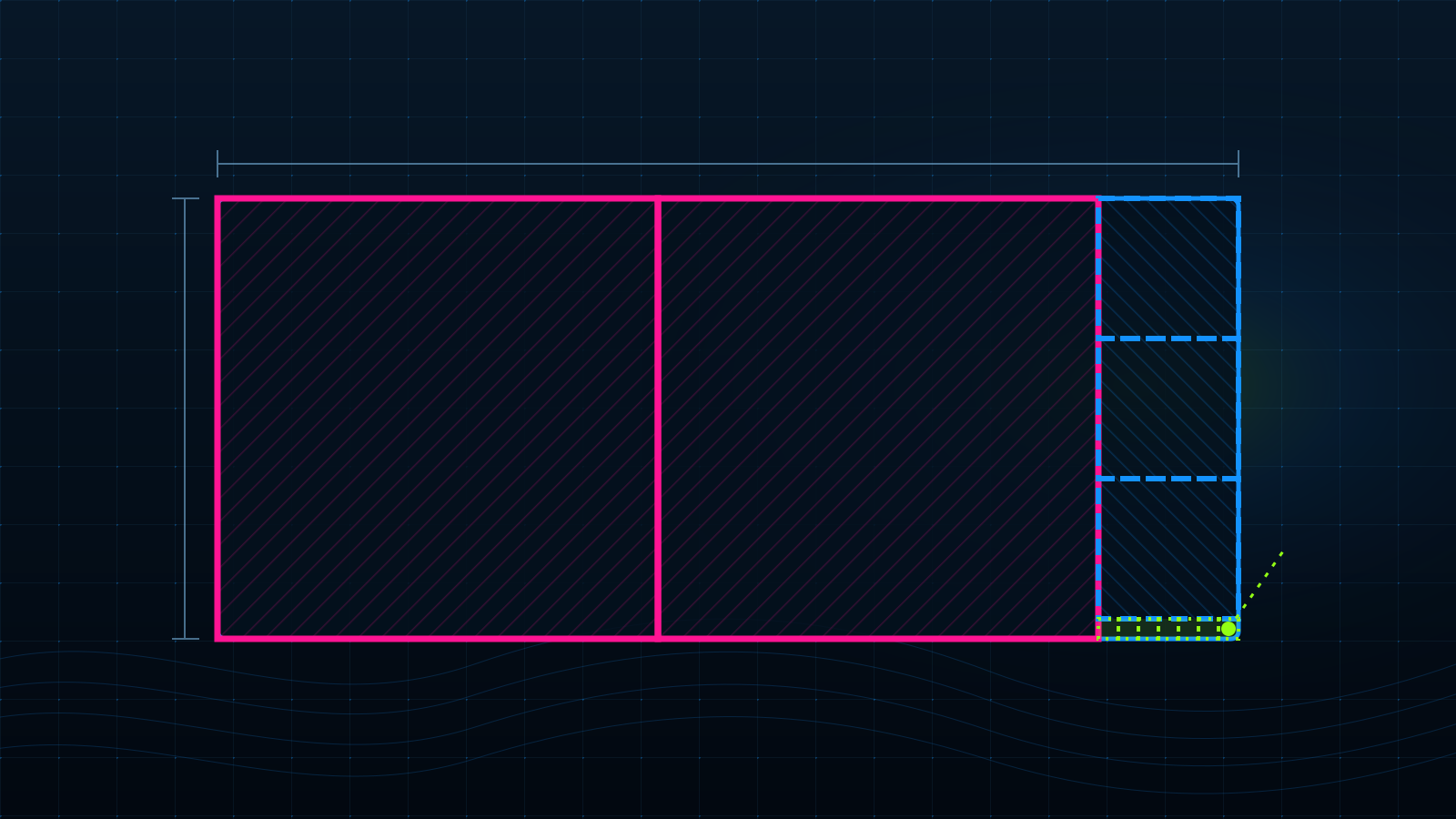
The diagram treats the rope lengths as the sides of a rectangle. Removing a square corresponds to subtracting one side length from the other. Removing several equal squares at once corresponds to division with a remainder.
Remainder explorer
A rectangle remembers its common measure
Division chain
- 1071 = 2 × 462 + 147
- 462 = 3 × 147 + 21
- 147 = 7 × 21 + 0
The last nonzero remainder is 21.
Two 462-unit squares use 924 units of the long side; a 147-by-462 rectangle remains.
The colors mark successive divisions, while solid, dashed, and dotted outlines repeat the same information without color. Choose another rectangle or reveal the divisions one at a time. Every remainder becomes the shorter side of the next rectangle.
The rule
Let and be positive integers with . Whole-number division writes in exactly one form
where is a nonnegative integer called the quotient, and the remainder satisfies
The greatest common divisor of and , written , is the largest positive integer that divides both numbers without a remainder.
The Euclidean algorithm rests on one identity:
Why can the remainder replace the larger number? Take any common divisor of and . Because divides both terms in , the same divides
Now run the reasoning backward. If divides and , then divides
The pairs and have exactly the same common divisors. Their greatest common divisor must be the same.
If is not zero, divide again. Each positive remainder is smaller than the divisor immediately before it, so the decreasing sequence cannot continue forever. When a division finally has remainder zero, its divisor is the answer.
Worked example: 1,071 and 462
Start by dividing the larger number by the smaller:
The identity gives
Now divide 462 by 147:
so
One more division finishes the chain:
The last nonzero remainder is 21. Therefore
The answer passes the original test:
Both ropes split into 21-centimeter pieces. No longer common length can work, because every common divisor survived each replacement and the final pair, , has 21 as its largest common divisor.
What the rectangle proves
The rectangle is more than a picture of the arithmetic. Suppose a square tile has an integer side length that covers an -by- rectangle exactly. The tile’s side must divide both and . The largest possible square tile therefore has side length .
For the 1,071-by-462 rectangle, two 462-by-462 squares leave a 147-by-462 strip. Three 147-by-147 squares leave a 147-by-21 strip. Seven 21-by-21 squares fill that strip. The final square side, 21, is the largest length capable of tiling every earlier region.
The same logic explains a practical habit: reduce a fraction by dividing its numerator and denominator by their greatest common divisor. Because ,
The reduced fraction preserves the ratio while removing every factor shared by the two terms.
Two ancient records, two mathematical settings
The procedure carries Euclid’s name because Book VII, Proposition 2 of the Elements, composed around 300 BCE, gives a method for finding the “greatest common measure” of two numbers. David Joyce’s edition of Proposition VII.2 preserves Euclid’s geometric language. A Mathematical Association of America study of the source notes that Euclid described numbers as lengths and that historians can read the repeated removals as subtraction or as the larger division steps used today.
A related greatest-common-divisor procedure survives in China’s Nine Chapters on the Mathematical Art. The text’s authors and exact date are unknown; evidence inside the work suggests compilation shortly after 200 BCE. Its first chapter uses repeated subtraction while reducing fractions. Liu Hui added explanations in a commentary dated 263 CE. The Mathematical Association of America’s history of the Nine Chapters places those rules among calculations for fields, grain exchange, construction, wages, and taxes. The book later served mathematical education connected to China’s imperial bureaucracy.
The surviving Greek and Chinese texts embed a similar operation in different projects. Euclid’s Elements organizes propositions into deductive number theory. The Nine Chapters organizes worked rules around administrative and economic problems. The records do not justify a story in which one named person invented every version of the idea.
The English word algorithm has a separate lineage. It comes through medieval Latin versions of the name al-Khwārizmī, the ninth-century scholar whose writings helped transmit Hindu-Arabic arithmetic. The MacTutor biography of al-Khwārizmī traces that word history. “Euclidean algorithm” therefore joins a Greek attribution to a word whose route into European languages runs through a Persian scholar working in Abbasid Baghdad.
Where the same remainder chain works now
Computers use greatest common divisors to reduce exact fractions, normalize ratios, and decide whether two integers are coprime, meaning that their greatest common divisor is 1.
An extended version of the algorithm tracks how each remainder was assembled from the original numbers. That bookkeeping can find a modular inverse: a number that reverses multiplication when only remainders modulo a fixed integer matter. The connection is not historical decoration. Appendix B.1 of the current National Institute of Standards and Technology Digital Signature Standard gives a reference inverse routine built from successive quotients and remainders. The standard uses such inverses in public-key signature procedures.
The site’s lesson on RSA encryption shows why an inverse exponent can unlock a message. The Euclidean algorithm supplies the arithmetic needed to find inverses of that kind when they exist.
Try the chain yourself
Problem 1
Find with the Euclidean algorithm.
Reveal the solution
Divide repeatedly:
The last nonzero remainder is 18, so
As a check, and .
Problem 2
What is the side length of the largest integer-sided square that can tile a 391-by-299 rectangle? How many of those largest squares cover the rectangle?
Reveal the solution
The square’s side is . Compute it:
The largest square has side length 23. The rectangle is
squares long and
squares wide. The total number is
The idea to keep
Replacing by keeps every common divisor and makes the numbers smaller. The last nonzero remainder is therefore the greatest common divisor.
Continue with modular arithmetic on a clock to see how remainders become their own number system, then follow the RSA round trip to see why coprimality and modular inverses matter.
Sources
- Euclid, Elements, Book VII, Proposition 2, translated and edited by David E. Joyce, Clark University.
- Jerry Lodder, David Pengelley, and Desh Ranjan, “Euclid’s Algorithm for the Greatest Common Divisor,” Convergence, Mathematical Association of America, July 2013.
- Randy K. Schwartz, “A Classic from China: The Nine Chapters — Introduction and History,” Convergence, Mathematical Association of America, December 2018.
- National Institute of Standards and Technology, Digital Signature Standard (DSS), FIPS 186-5, February 3, 2023, especially Appendix B.1.
- University of St Andrews MacTutor History of Mathematics Archive, “Abu Ja’far Muhammad ibn Musa Al-Khwarizmi.”