The Daily Reckoning
Why Does the Shortest Bounce Obey the Law of Reflection?
Reflect one endpoint across a mirror and a bent route becomes straight. That single construction finds the shortest bounce and explains why the incoming and outgoing angles match.
- Difficulty
- Intermediate
- Area
- Geometry and optimization
- Reading time
- 9 minutes
- Prerequisites
- Coordinates in the plane · The distance formula · The triangle inequality
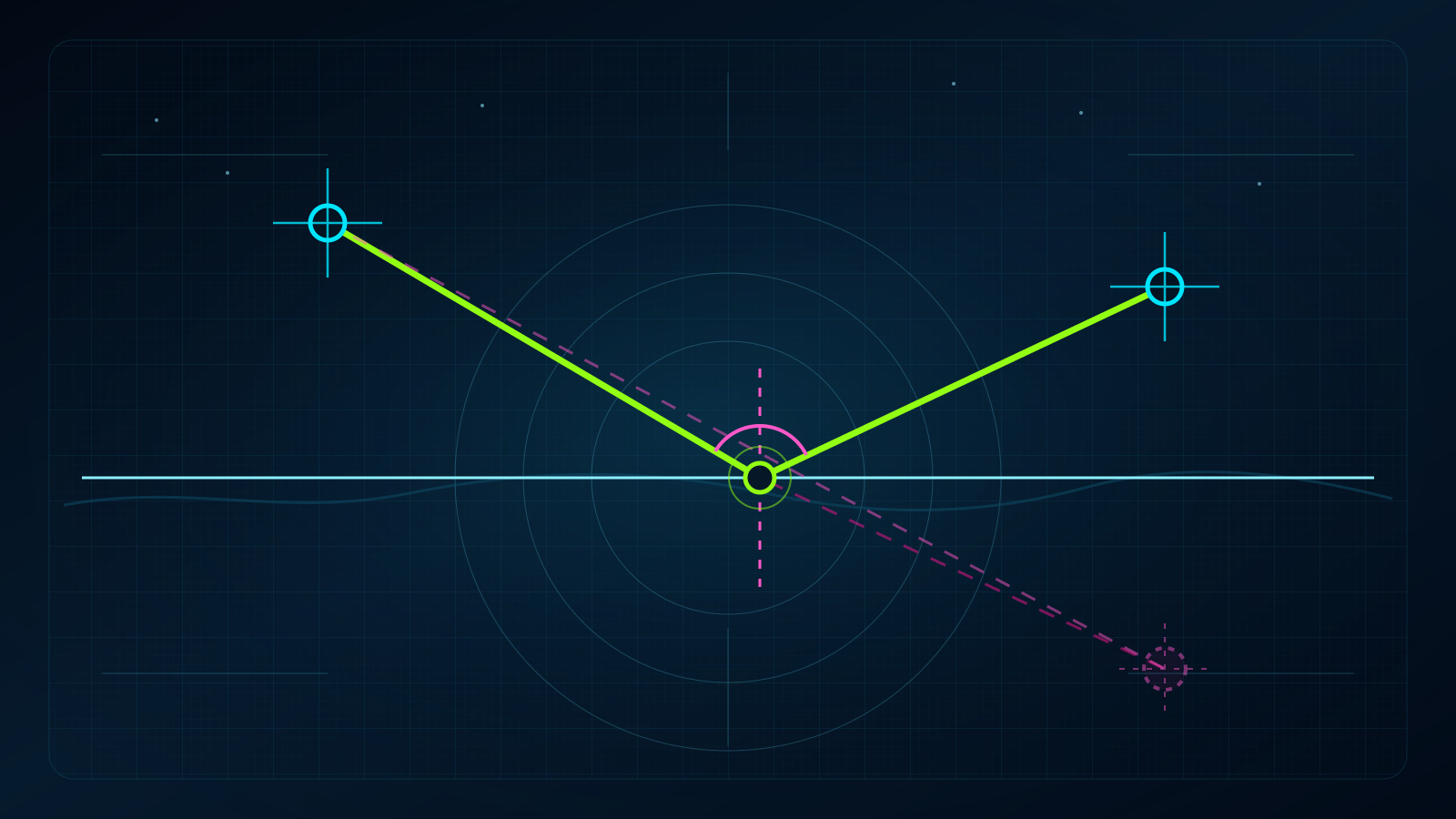
A billiard ball must touch one cushion before reaching a target. Where should the ball strike the cushion if you want the shortest possible route?
Trying points one by one will find an approximation. Geometry finds the exact point without searching.
The trick is to reflect the target across the cushion. The required path still looks bent on the real table, but its reflected copy becomes a straight segment. Because a straight segment is the shortest route between two points, the reflected picture solves the optimization problem at once.
The same construction explains the familiar law of reflection: the angle at which a ray arrives equals the angle at which the ray leaves.
Unfold the bounce
Let the horizontal line be a mirror. Points and lie on the same side of . A route begins at , touches the mirror at a point , and ends at . Its total length is
where and denote the lengths of the two segments.
Reflect across to a point . Reflection preserves distance from every point on the mirror, so
The broken route therefore satisfies
Now apply the triangle inequality to the three points , , and :
Equality occurs exactly when , , and lie on one straight segment, with between the other two points. The shortest physical route is therefore found by drawing the straight line from to and recording where that line crosses the mirror.
The interactive diagram uses one fixed pair of endpoints. Move along the mirror and compare the route’s length and angles. The dashed segment from to is a construction; the solid segment from to is the reflected physical route.
Reflection laboratory
Move the bounce point and watch the broken path change
At P = 38/7, the solid incoming segment and the dashed segment to B′ form one straight line. The total length is √85, the minimum.
Why the two angles match
At the minimizing point, the straight line from to crosses the mirror at . Reflect the segment back across the mirror. The reflected segment is .
Reflection preserves angles. The angle between and the mirror equals the angle between and the mirror. Because and form one straight line, the angle made by on one side of the normal matches the reflected angle made by on the other side.
Optics usually measures both angles from the normal, the line perpendicular to the mirror at . If is the incoming angle and is the outgoing angle, the law of reflection is
Measuring from the mirror instead would produce the same equality because each angle from the mirror is the complement of its angle from the normal.
Worked example: find the exact bounce point
Place the mirror on the -axis,
Let the starting point be and the target be . We will find the point that minimizes .
Step 1: reflect the target. Reflecting across the -axis changes the sign of the vertical coordinate, so
Step 2: write the straight segment from to . A point on that segment has the form
where runs from at to at .
Step 3: find where the segment reaches the mirror. The vertical coordinate is
At the mirror, that coordinate equals :
The horizontal coordinate at the same value of is
Thus the exact bounce point is
Step 4: calculate the minimum length. The unfolded route is the straight segment , so
Step 5: check the angles independently. From to , the horizontal change is
while the vertical change has magnitude . The tangent of the angle from the vertical normal is therefore
From to , the horizontal change is
while the vertical change is . Hence
Both acute angles lie between and , so equal tangents give
The reflection construction, the minimum-length calculation, and the angle check all select the same point.
A principle with a long optical history
The equal-angle rule predates the shortest-path proof. The Oxford Classical Dictionary’s survey of catoptrics describes an ancient Greek tradition that included a Catoptrica attributed to Euclid, although the attribution is disputed, and later treatments associated with Hero of Alexandria and Ptolemy.
Hero’s distinctive contribution was to connect reflection with a minimum. A problem in Hero’s Catoptrica, usually dated to the first century CE, shows that the equal-angle route has the shortest length among paths that touch a plane mirror. The University of St Andrews account of the minimal-path problem presents the same construction used in this lesson.
That history should not be compressed into “Hero discovered reflection.” Earlier writers knew the equal-angle rule, and Ptolemy’s optical work included experimental measurements. Hero supplied a powerful way to derive the rule from an extremal path.
In the mid-seventeenth century, Pierre de Fermat proposed a broader principle: a light ray follows a path whose travel time is stationary under small changes. In the flat-mirror problem, light stays in one medium and moves at constant speed, so minimizing time is the same as minimizing distance. The Feynman Lectures’ chapter on least time works from that optical principle toward reflection and refraction.
“Least time” is a useful historical name, but stationary time is the more general modern statement. In some optical systems, the physical path need not be the globally shortest path. The one-reflection problem on a flat mirror really does have the unique minimum proved above.
Where unfolding earns its keep
The construction is useful whenever a path reflects from a flat boundary.
A billiards player can reflect the target across a cushion, aim along the resulting straight line, and recover the intended contact point on the real cushion. The model assumes an ideal point ball, a perfectly elastic collision, no spin, and no energy loss. Real tables violate those assumptions, but the unfolded line remains the geometric starting point.
Geometric optics uses the same equal-angle law for plane mirrors. The OpenStax account of reflection defines the incoming and reflected angles relative to the surface normal and applies the rule to mirror images.
Computer graphics turns the construction into an algorithmic operation. A ray tracer follows a viewing ray to a surface, computes a reflected direction from the surface normal, and traces the new ray through the scene. NVIDIA’s ray-tracing overview describes ray tracing as a technique used in film, television, and real-time video games. Production renderers also model roughness, scattering, absorption, and many bounces; the perfect mirror is one exact case inside a larger rendering problem.
Unfolding extends beyond a single bounce. A rectangular billiard path with several cushion strikes can be straightened by reflecting the entire table after each strike. The ball’s complicated route in the original table becomes one line through a tiled collection of reflected tables. That idea opens a door from elementary geometry into the mathematical study of billiards and dynamical systems.
Try the construction
Problem 1
The mirror is the -axis. Let and . Find the bounce point that minimizes , and find the minimum length.
Reveal the solution
Reflect across the -axis:
Parameterize the segment from to :
Its vertical coordinate reaches when
The horizontal coordinate is then
Therefore
The minimum length is the straight distance from to :
Problem 2
Two points are and above the mirror . Without using calculus, find the shortest route from to the mirror and then to . Explain why the bounce point lies halfway between the endpoints.
Reveal the solution
Reflect to
The line from to changes its vertical coordinate from to . It reaches halfway along the segment. Halfway between the horizontal coordinates and is , so
The minimum length is
The equal heights of and make the reflected picture symmetric around the vertical line . That symmetry places the bounce point halfway between them.
The idea to keep
Reflect the target across a flat boundary. Every broken path keeps the same length after unfolding, but only the minimizing path becomes a straight segment. Straightness gives the shortest route, and folding the segment back makes the incoming and outgoing angles equal.
To continue, Why Do the Shortest Three Roads Meet at 120°? studies another geometric minimum, while Why Can a Particle Cross a Wall It Cannot Climb? shows where wave mechanics departs from a purely ray-like picture.
Sources
- University of St Andrews, “Minimal Path: Minimal path between two points via a line”, the reflection construction and its attribution to Hero.
- A. Mark Smith, “Catoptrics,” Oxford Classical Dictionary, ancient treatments of reflection and the disputed attribution of Euclid’s Catoptrica.
- Richard P. Feynman, Robert B. Leighton, and Matthew Sands, “Optics: The Principle of Least Time,” The Feynman Lectures on Physics, Volume I, Chapter 26.
- OpenStax, “The Law of Reflection,” University Physics Volume 3.
- Delft University of Technology, “Geometrical Optics”, Fermat’s principle, optical path length, reflection, and refraction.
- NVIDIA, “Ray Tracing”, current applications in offline and real-time computer graphics.