Save Point · A daily JRPG corner
Save Point: The Ring That Won't Let a Turn Become Automatic
Shadow Hearts makes every command a small performance; Final Fantasy IV discovers that real-time combat needs room to think; and FFXIV repairs grief into a family routine.
Approximately 12 minutes
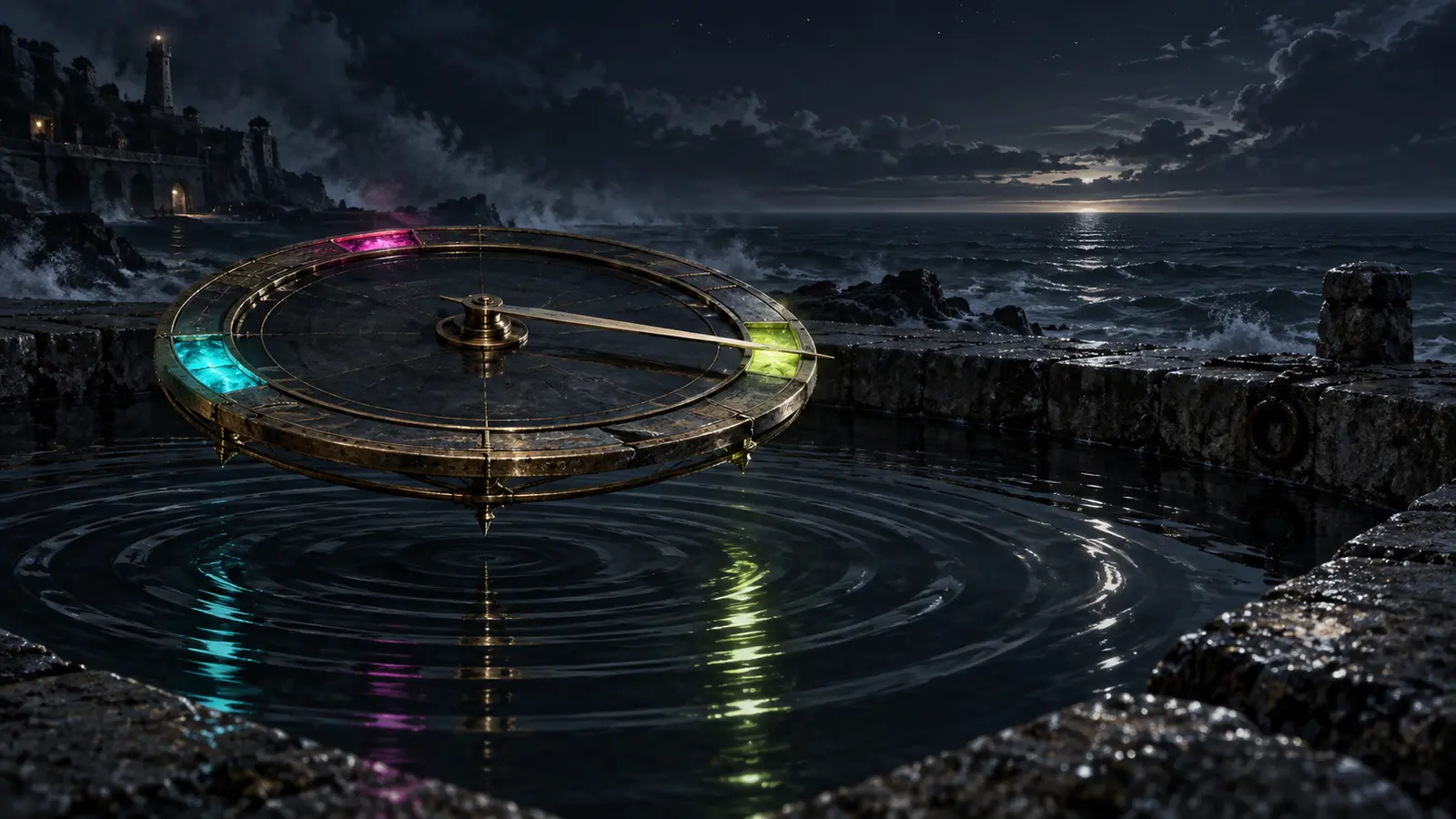
Three role-playing games stop time from becoming invisible. Final Fantasy IV discovers that a fast battle still needs pauses the player can understand. Final Fantasy XIV turns a repaired object into a decade-long habit between siblings. Shadow Hearts draws a circle around the instant when intention becomes action.
The feature belongs to Shadow Hearts. Its Judgment Ring adds no new command to the menu. It changes what every command asks of the person holding the controller.
Final Fantasy: Speed needed time to think
The first version of Active Time Battle succeeded at movement and failed at legibility.
In Square Enix’s 30th-anniversary interview about Final Fantasy IV, lead designer and scenario writer Takashi Tokita remembers an early build in which everyone simply acted according to speed. The result was not strategic urgency. Nobody could tell what was happening, there was no room to consider weaknesses, and play collapsed into button-spamming.
The repair was not to abandon time. The team gave it shape. Tokita says the designers added a form of “waiting time,” let ordinary attacks resolve promptly, and delayed stronger summons and some magic. The difference between commands could now be felt as duration rather than represented only by a damage number.
Tokita attributes Hiroyuki Ito’s original idea to watching Formula One cars on different laps: a fast participant might act twice while a slower one acted once. He also describes the system’s playable form as a set of character-specific rules. Speed alone was too blunt. Edge could be quick but weaker; a summon could be powerful but late. Timing became a way of expressing identity and cost.
The surrounding character design reduced another kind of speed. Tokita says the team kept familiar, fixed jobs because ATB itself was already new; unfamiliar commands on top of an unfamiliar clock would have added confusion. A dragoon, summoner, or monk arrived with expectations the player could carry into a party whose membership kept changing with the story. Mechanical novelty was made readable by placing it inside recognizable roles.
The interview adds one more complication. Final Fantasy IV introduced enemies that react to particular player actions, and ATB lets those counters arrive between ordinary attacks. A command therefore occupies a place in traffic. The question is not only whether an elemental spell is correct, but what may move while the decision resolves.
That also explains why battles could hold dramatic scenes instead of remaining separate from them. Tokita describes the battle screen as a place where characters were shown off and story events could unfold. If time, role, and command all belonged to a character, the system could carry characterization rather than pausing it. The moving queue was not simply faster turn-taking; it was a stage on which entrances, absences, and delayed acts had weight.
That history makes the familiar gauge look less like the invention than the compromise around it. Continuous time created pressure immediately. The actual design work was deciding where pressure should yield to comprehension. Final Fantasy IV did not make turns disappear. It taught turns how to overtake one another, then built enough distance between them for the player to see the race.
Final Fantasy XIV: A repair becomes an old routine
Square Enix published “An Old Routine” on September 4, the sixth story in this year’s Tales under the Golden Sun. Its title sounds domestic because its real subject is what happens after catastrophe becomes family history.
Major spoilers · Final Fantasy XIV: DawntrailAlliance-raid characters, Doomtrain aftermath, and the siblings' family historyReveal
Lumull begins after a celebration in Treno by inventorying his failures. He broke Eyaney’s monster detector. He forgot to organize repairs during a crisis. Even the restored barrier overhead becomes evidence that his sister is capable in ways he believes he is not.
The story then returns to the first thing the siblings had to repair. Ten years earlier, the Doomtrain destroyed their neighborhood and killed their parents, Noson and Matheya, after the couple stayed behind to direct neighbors toward shelter. Lumull responds by deciding that grief is another job he should be able to perform for his younger sister. He cannot stop her pain, so he starts digging through the ruins for proof of their former life.
What begins as solitary penance becomes communal work. Other residents join him. Some want belongings of their own; some simply find that moving rubble makes sorrow bearable. The recovery effort does not separate labor from mourning. Steel striking stone, laughter, recovered seeds, burials, and practical requests all occupy the same days.
Lumull eventually finds his parents’ two pairs of goggles. His impatient reach shifts the debris and breaks them. When he apologizes to Eyaney, she first asks whether he was hurt. Then she cries, smiles, and decides she can learn enough engineering to mend what he keeps damaging.
The goggles matter because the story refuses a perfect restoration. The parents do not return. The old home cannot be rebuilt by retrieving one object. Instead, the siblings wear matching repairs and repeat a smaller exchange: Lumull risks himself helping somebody, a device breaks, Eyaney scolds him, then sits down to fix it while he stays nearby.
That repetition could be a joke about a reckless brother and a competent sister. “An Old Routine” lets it remain funny while revealing the promise underneath. He keeps going toward people in danger. She keeps making damaged things usable. Neither act cancels what was lost, but together they have become a way of saying that both siblings still prefer the other to remain among the living.
Beyond Final Fantasy: The command answers to your hand
Most menu commands hide the seam between deciding and doing. Choose Attack, and the character attacks. Choose an item, and the item works unless a rule inside the simulation says otherwise. The player’s hand points toward an intention; the game takes responsibility for execution.
Shadow Hearts puts the seam on screen.
In Earlybird’s hour-long retrospective, nearly every action passes through the Judgment Ring. A pointer sweeps around a circle marked with target areas. Press the button while the pointer crosses a colored region and the command succeeds; miss, and a hit can vanish or the action can fail. Narrower red portions at the far edge of target areas reward more exact timing with greater effect.
The first useful thing Earlybird notices is that the ring is not confined to battle. It appears when the player shops for a discount and when a lock needs picking. That repetition makes the circle more than a combat flourish. The world keeps asking the same question in different clothes: you have chosen what you want—can you complete the motion?
Earlybird describes the balance as approachable without being inert. A player who rarely lands perfect strikes can still finish the game, while practice and riskier target areas create a meaningful advantage. The video also notes that items can enlarge zones or make timing easier, while enemy effects can shrink the targets or hide them entirely. A status effect does not merely subtract accuracy behind the curtain. It changes what the player is able to see and perform.
That last variation exposes why the ring works. Its baseline difficulty is visible before the pointer begins to travel. The player can read the size and placement of the demand. Failure feels attached to a particular instant rather than a probability disclosed after the command. When the targets disappear, the game is not just raising a number; it is taking away information the player’s learned movement depends upon.
That visibility creates an unusually clean agreement. The game shows the window, the pointer shows time approaching it, and the player’s press resolves the attempt. A narrow target can be intimidating without requiring a tutorial sentence about percentages. A widened target can feel generous before it produces a result. Difficulty moves from a hidden calculation into the same visual space as choice.
Director and writer Matsuzo Machida describes the design from the other side in a later interview translated into English. The team drew from beat-‘em-ups but replaced complicated combinations with a single timing action suitable for an RPG. Machida says the visible hit areas were meant to make difficulty understandable by sight. The ring borrows the physical accountability of an action game without asking a menu-driven RPG to become one.
This is not the same as placing a surprise quick-time event inside a cutscene. The Judgment Ring is announced, repeated, and allowed to become a skill. Because it accompanies ordinary attacks, magic, items, purchases, and small environmental tasks, it develops into a grammar. The player learns how Shadow Hearts conjugates a verb: select it, watch the circle, commit.
It also avoids treating manual input as a synonym for complexity. The action remains one button pressed at the right moment. Tactical thought stays in party composition, targets, abilities, and items; the ring does not demand that all of those decisions be converted into dexterous combinations. Its contribution is narrower and more consistent. After strategy chooses the action, timing asks the player to inhabit its last second.
Earlybird’s final judgment keeps the praise honest. The creator loves the system but objects that the game can still apply an ordinary random miss after the player successfully lands three ring inputs. That complaint identifies a broken promise. Once the interface makes execution personally legible, a second invisible accuracy check feels less like another challenge than a refusal to honor the first one.
The ring therefore changes more than difficulty. It reallocates authorship. A strong attack is partly the character’s statistic and partly the player’s practiced hand. A discount is partly a shop rule and partly nerve. Even a debuff can interfere with the relationship between seeing and moving.
Repetition is essential to that transfer. If the ring appeared only for spectacular attacks, it would mark exception. By returning for mundane purchases and small obstacles, it makes uncertainty ordinary. The same practiced motion accompanies violence, bargaining, and handiwork, even though their consequences differ. Shadow Hearts gives its world a common measure of follow-through: intentions are easy to declare, and completion occupies a window that can be missed.
Turn-based combat is sometimes described as passive because the controller can rest while the player thinks. Shadow Hearts does not discard thought or menus. It simply refuses to let a decision travel the final distance by itself. Every command stops at the same round checkpoint and waits for the player’s hand to answer.
Source trail
- Square Enix, “FINAL FANTASY IV 30th Anniversary Special Interview”, July 19, 2021. Official interview with Takashi Tokita about the game’s story and battle-system development.
- Square Enix, “Tales under the Golden Sun Updated!”, September 4, 2026, and “An Old Routine”, the official sixth side story.
- Earlybird, “Dark RPG That Pulls Off Humor and Tragedy | Shadow Hearts”, February 24, 2024. Full English caption transcript reviewed; runtime 1:00:23.
- Matsuzo Machida and Miyako Kato, Shadow Hearts creator interview, English translation of an Italian interview; publication date not stated on the English page.