Save Point · A daily JRPG corner
Save Point: The Ordinary Motion Had to Survive 3D
Final Fantasy VII made personality a production problem; FFXIV changes a body's animation anchor at the waterline; and Mother refuses to let a town speak with one voice.
Approximately 11 minutes
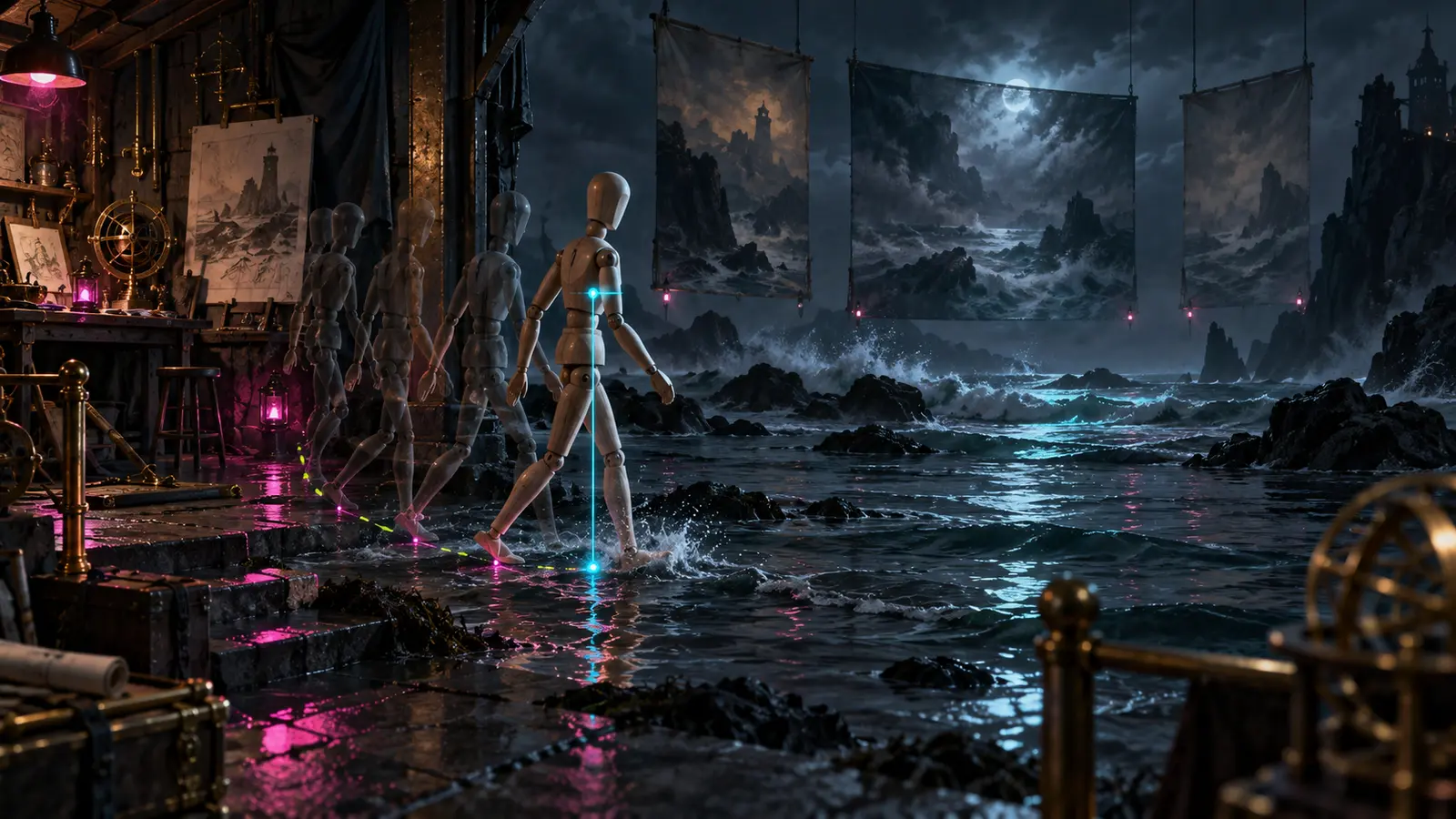
Today’s edition is about the work required to keep a system from flattening the people inside it. Final Fantasy VII had to teach a much larger production how a character moves when no battle is happening. FFXIV had to make very different bodies meet the same waterline. Mother had to stop hundreds of neighbors from sounding like copies of one another.
The feature belongs to Final Fantasy VII. Square’s move into 3D is usually remembered as a technological jump. The developers’ own account makes it sound equally like a problem of ordinary motion: once a body can turn, gesture, ride, and occupy a composed image, personality has to survive the machinery that makes all of that possible.
Final Fantasy: Personality became a production problem
The first thing Square decided about Final Fantasy VII was not its opening movie. Director Yoshinori Kitase recalled that the team first settled how camera angles would change during battle. It also established materia early, making combat abilities transferable through equipment rather than fixed inside particular characters.
Those choices sit on opposite sides of a useful tension. The camera would make each action more specifically staged. Materia would make each fighter less mechanically predetermined. Final Fantasy VII could declare one central protagonist, unlike the deliberately distributed ensemble of Final Fantasy VI, while still letting the player reassign much of what the party could do. Character would have to remain legible somewhere other than the command list.
Three dimensions made that task newly physical. Tetsuya Nomura said the old two-heads-tall proportions could not simply be carried into real-time models: an overhead sword motion would send a weapon through its owner’s enlarged head. Yusuke Naora pointed to a more mundane expansion. Once bodies had different proportions, they could convincingly ride vehicles that would have looked awkward beneath the old sprites.
The striking part is what happened after the proportions changed. Main programmer Ken Narita explained that motion for in-game events was not handed to a separate animation department. Designers in the planning group learned to animate the characters themselves. One preferred broad gestures; another moved characters quietly. Battle animation did go to dedicated motion specialists, but the acting between fights retained the habits of the people who had planned the scenes.
Nomura was exacting about those habits. Colleagues remembered him demanding retakes, and he singled out everyday movement as the place where a character’s personality appears. That priority complicates the familiar story of Final Fantasy VII as a parade of unprecedented spectacle. Its new bodies mattered because they could perform the unremarkable seconds too: turn toward someone, hesitate, react, cross a room. A dramatic summon announces itself. An ordinary gesture has to feel right before the player thinks to inspect it.
The environments underwent a related change. Earlier towns had been assembled from reusable houses, streets, fences, and foliage. Naora’s team could now present a field as a single seamless image. The gain was not just detail. A place could be composed as a place, with varied terrain and small signs of occupation extending to beds, toilets, and images tucked onto walls. Repetition was no longer imposed by the tile set, so the background could carry specificity of its own.
Yet this apparent unity was being manufactured from separate kinds of work. Pre-rendered movies, static fields, real-time characters, battle spaces, effects, and an overworld had different artists and technical constraints. Narita considered the smooth passage between movies and field scenes both a point of pride and one of the hardest programming problems. Late in development, he said, those separately made parts were finally joined. Only then did several contributors feel the force of the finished game.
The team itself had to cross those boundaries. Hironobu Sakaguchi estimated that 80 to 90 percent of the fields and mechanics came from Square’s established game staff, while newly hired computer-graphics specialists brought knowledge of different hardware and production techniques. Kitase emphasized that the CG artists did not operate as a detached unit. The old staff learned from them, and the specialists were asked to make their work function inside a game rather than alongside it.
That exchange gave restraint a new importance. Battle-background artist Akira Fujii received field artwork built at high polygon counts, then had to decide which elements mattered enough to preserve when reconstructing a space for real-time combat. Effects programmer Yasui Kentarou faced summon storyboards that initially looked impossible. In both cases, the job was not to reproduce every input literally. It was to identify the image’s decisive action or shape and make that survive another technical context.
Even the soundtrack’s technical restraint served that continuity. Nobuo Uematsu used the PlayStation’s internal sound hardware instead of streaming studio recordings from the CD. The console offered more voices and range than the Super Famicom, but the decisive advantage was practical: music placed fewer demands on disc access, reducing interruptions while the player moved through the game.
That makes the production’s cinematic ambition more precise. Kitase wanted movies, fields, and battles to feel like one work, with compositions carrying authorial intent. The team did not achieve that simply by adding film. It designed transitions so that one representational system could hand the player to another without breaking the scene.
Final Fantasy VII therefore treats coherence as active labor. A character designer draws a body that can clear its own motions. A planner learns animation so a scene retains a personal cadence. A programmer conceals the boundary between video and play. A composer chooses the less ostentatious audio method because waiting would puncture the journey. The famous leap to 3D was not one leap at all. It was a collection of careful landings—and the smallest gesture was where the new machinery had to disappear.
Final Fantasy XIV: The body’s anchor moves at the waterline
On dry ground, FFXIV can treat a character’s feet as a point of reference. That shared anchor allows one family of animations to serve playable characters with widely different proportions. The floor supplies a reliable fact: however tall the body, the feet should meet it.
Water breaks the fact.
Lead technical artist Tatsuya Okahisa encountered the problem while helping add swimming and diving for Stormblood. If the game continued to align every physique from the feet, the distance from foot to water surface made a Lalafell appear to sink while a Roegadyn floated too high. The same correct calculation produced two visibly wrong swimmers.
The solution was to change what the body meant to the system. Okahisa asked programmers for a procedure that quickly moves the point of reference from the feet to the chest when a character enters water. The technical-art work also covered how a swimming animation should synchronize with splashes and how swimming and diving motions should blend. None of these details is the feature as advertised to a player. Together, they make the advertised feature look as if it naturally belonged to every body already in the world.
Okahisa describes technical artists as intermediaries who understand both code and how artists construct data. Their tools automate predictable work, but their deeper value appears when the prediction fails. The land animation was reusable because every character shared a ground plane. At the waterline, the team had to identify a different invariant.
For a continuously updated game, the fix also has to survive tomorrow. Okahisa’s working principles include designing for maintenance, respecting a feature’s intended scope, and avoiding conflicting implementations. An elaborate solution may look clever at launch and become expensive each time a new update touches it.
The chest anchor is elegant because it is not a bespoke pose for each race. It changes the rule at the precise boundary where the old rule stops describing what the eye expects. FFXIV’s water does not merely add an area through which characters can travel. It exposes how the game understands a body—and forces that understanding to move.
Beyond Final Fantasy: A town should not have one voice
Shigesato Itoi approached RPG conventions as dissatisfactions players had learned to tolerate. Towns became icons when entered. Non-player characters repeated the same line. Medieval European imagery arrived secondhand through familiar fantasy. In a 1989 interview, he described Mother as an attempt to prove that those accommodations were not the edge of the form.
His alternative began close to home. Itoi did not pretend expertise in medieval Europe, so he built a contemporary adventure out of recognizable streets, houses, children, and speech. A visit to Chicago supplied visual experience. The party could be named at the beginning, but its members would join and part through the story rather than through a free character-switching menu. The change in company was itself meant to create drama.
Dialogue received the same structural attention. Itoi estimated that the game contained more than 300 people and that almost none shared a line. Enemy messages could vary with the opponents and their number. Conversation was not flavor sprinkled over the mechanical town. Its abundance was one of the game’s systems, large enough that Itoi said making Mother taught him how difficult words could be.
That choice changes what an NPC does. A repeated greeting confirms a category: this is a villager, this is a shopkeeper, this is someone who has nothing further to say. An individual line asks the player to regard the speaker as a particular comic beat, worry, interruption, or point of view. The town stops behaving like a menu with legs and becomes a crowd.
Itoi applied a similar principle to sound. He wanted music to do more than supply conventional background accompaniment. Because it is invisible, he believed it could misdirect the player and enlarge the sensed world. That description joins music and dialogue as forms of presence: one makes people specific; the other makes unseen dimensions felt.
Mother did not escape every convention it questioned, nor did Itoi claim technical scale as the measure of progress. His counterexample was deliberately small: one fascinating character and an exciting story could matter more than proving that a machine could hold ten party members. The radical unit was not capacity but attention.
That is why the hundreds of distinct lines remain more than a writing statistic. Itoi treated ordinary speech the way Final Fantasy VII treated ordinary movement. If a role-playing game was going to persuade the player that people inhabited its machinery, the moments between its grand events could not all be interchangeable.
Source trail
- shmuplations, “Final Fantasy VII – 1997 Developer Interviews”, December 25, 2021. English translation compiling contemporary interviews originally published in Japanese magazines in 1997.
- Square Enix, “FFXIV Backstage Investigators (No. 7): Lead Technical Artist Tatsuya Okahisa”, October 11, 2021.
- shmuplations, “Mother – 1989 Developer Interview”, January 3, 2022. English translation of a 1989 interview with Shigesato Itoi.