Morning Soundings
Morning Soundings: The Weather Inside a Glass of Water
A frog RPG abolishes money, satellites turn orbital clutter into landmarks, an ancient statue survives as pavement, and turbulence keeps the world just beyond prediction.
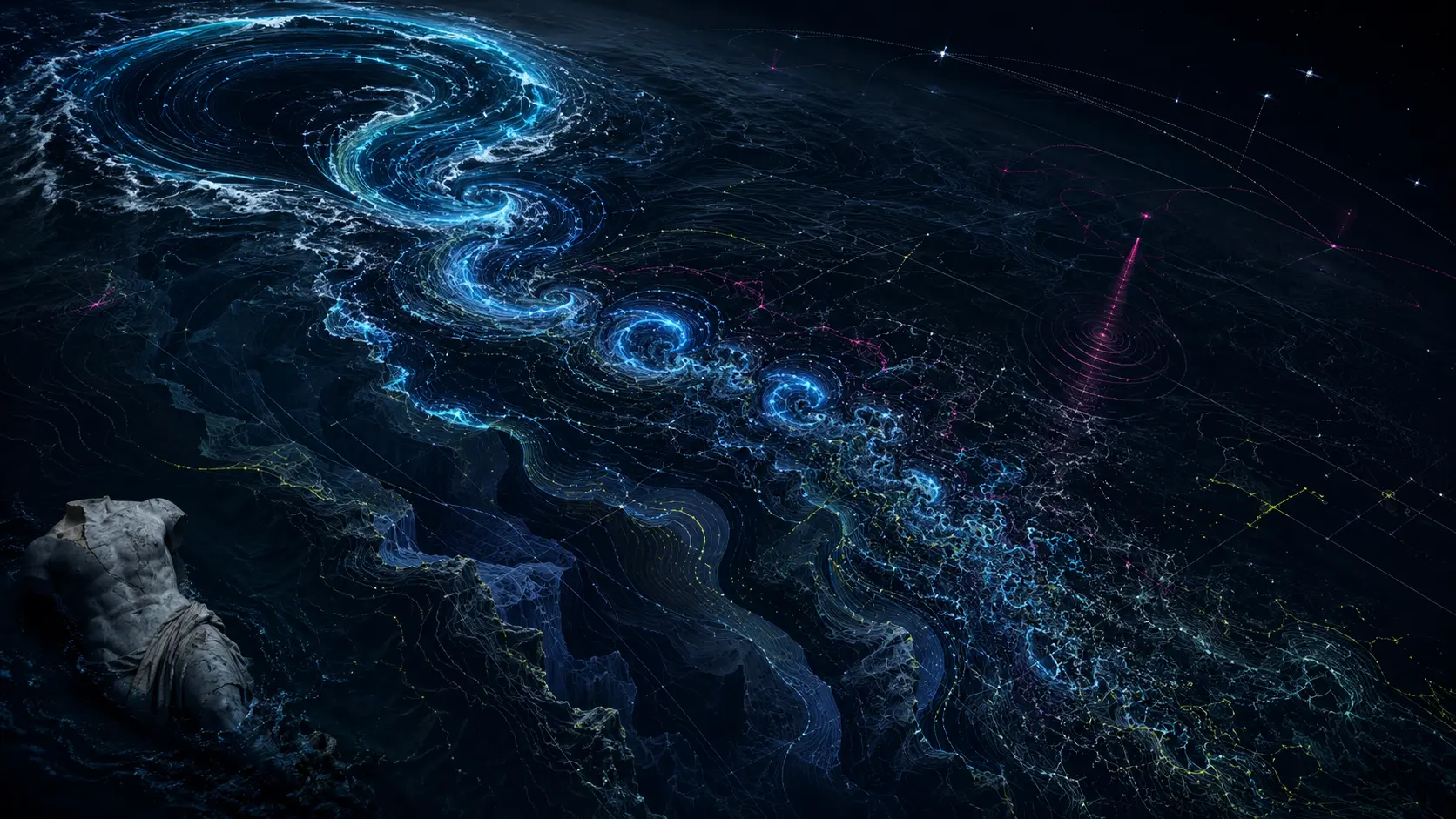
Morning Soundings: The Weather Inside a Glass of Water
The equations fit on a page. The water does not.
Today’s deeper question begins in a stirred cup and ends inside a fusion reactor: why does motion become so difficult to predict as soon as it becomes interesting? First, three smaller acts of subtraction and reuse—a role-playing game without money, a satellite without GPS, and a monument without its pedestal.
Three signals
A frog RPG has abolished money
The newly announced Amphibian begins with a drought and a war between frogs and toads. That sounds like a charming premise until the design starts removing the usual comforts of a role-playing game. Its official site says there are no shops, no buying or selling, no random encounters, and no level grinding. Battles are deliberately placed. Supplies dwindle. A hard hit can leave a party member with a persistent injury.
The absence of an economy is the interesting part. Most RPGs let time become power: fight long enough, accumulate enough currency, and a difficult problem eventually yields to repetition. Amphibian proposes a campaign in which the player cannot manufacture safety outside the story’s pressure. If the developers hold to that promise, every potion is also a decision about the future.
This is still a game targeting 2028, not a finished argument. “No grinding” can become “no recovery,” and scarcity can produce tedious perfectionism as easily as drama. But the design starts from a bracing first principle: if a story is about drought, deprivation should not stop at the cutscene boundary. The system should know that the pond is running dry. Gematsu’s announcement confirms planned versions for PlayStation 5, Xbox Series, Switch, and PC; the game’s own Steam page currently lists its release date as unannounced.
Satellites learned to use the traffic as a map
NASA’s Starling mission has demonstrated a GPS-independent navigation system that looks outward at other objects in orbit. FALCON—Fast Autonomous Lost-in-space Catalog-based Optical Navigation—matches spacecraft and orbital debris seen by ordinary star-tracker cameras against an onboard catalog, then uses those verified objects as reference points to estimate the observing satellite’s orbit.
The same process can run in both directions. During a three-day experiment, FALCON used a catalog of roughly 20,000 objects and improved the estimated orbits of more than 200 of them without ground intervention. NASA reports that the onboard predictions were more precise than the catalog data supplied by ground stations. Later this year, the four Starling spacecraft are expected to share observations and refine their positions collectively. The details are in NASA’s August 17 mission report.
This does not turn dangerous debris into something good. It does reveal a satisfying inversion. A crowded orbit makes navigation hazardous, but the visible crowd also supplies landmarks. Each spacecraft can become both traveler and surveyor, improving the map by using it.
Sardis paved a road with its own monument
Archaeologists at Sardis in western Türkiye have recovered a marble statue that would have stood more than seven feet tall. Its upright pose, long hair, and clothing look back toward sixth-century-BCE traditions, while the anatomy points to a later date, probably the 470s–450s BCE. That combination matters because Sardis had already passed from the Lydian Empire into Achaemenid Persian rule. The figure appears to remember an older local identity while its sculptor remained conversant with contemporary Mediterranean styles.
Its original purpose is unknown. Researchers are considering whether it may once have stood in the lost sanctuary of the mother goddess Cybele. They are also preserving any remaining flecks of paint; like most ancient marble sculpture, it was probably colored. Those are hypotheses under active conservation and analysis, not settled identifications.
The one certainty is its later indignity. The statue was broken into two large pieces and laid face-down as paving in a Roman colonnaded avenue. That reuse is why its front remained so well preserved. The Harvard-Cornell expedition’s account therefore gives us two histories at once: a culture monumentalized the figure, and another treated it as useful stone.
A museum preserves by removing an object from ordinary wear. Sardis accidentally preserved this one by putting it under everybody’s feet.
Deep sounding: the weather inside a glass of water
Yesterday the National Science Foundation announced three new Science and Technology Centers. One of them will spend up to $30 million over five years on a problem you can create with a spoon.
Stir water slowly and it follows the spoon in orderly layers. Stir faster and the motion breaks into swirls within swirls. Large eddies stretch and fold into smaller ones. Those smaller structures make smaller structures of their own until viscosity finally turns organized motion into heat.
That is turbulence in its most recognizable form. The same family of behavior moves heat through the atmosphere, mixes pollutants through water, determines drag around an aircraft, complicates combustion, and leaks energy from magnetically confined plasma. The new Michigan State–led center is called TEMPEST. It will combine experiments, mathematics, high-performance computing, and artificial intelligence in an attempt to make turbulent systems more predictable—and eventually more controllable.
The astonishing part is not that turbulence is complicated. The astonishing part is that we already know the basic rules.
For ordinary fluids, those rules are expressed by the Navier–Stokes equations. In rough language, they keep an account of momentum. Fluid accelerates because of pressure and external forces; viscosity smooths differences in velocity; and the moving fluid carries its own motion along with it. That last part makes the equations nonlinear. The current changes the current that will change the current.
There is an important distinction here. The Clay Mathematics Institute’s unsolved Millennium Prize problem asks whether sufficiently smooth three-dimensional solutions always continue to exist and remain smooth. It is a question about the mathematical foundations of the equations. Engineers do not wait for that proof before calculating airflow over a wing, and a proof would not instantly produce tomorrow’s weather. Practical turbulence prediction and Navier–Stokes existence-and-smoothness are related frontiers, not two names for the same problem.
The practical difficulty begins with scale.
Imagine watching a wide river curl around a bridge pier. The largest visible whirlpool may be meters across. Inside it live smaller eddies, and inside those live smaller ones again. In three-dimensional turbulence, motion stretches vortices and transfers kinetic energy from large scales toward progressively smaller scales. A Physical Review Letters study describes this cascade down to the range where motion is dissipated as heat—and argues that, at the very smallest gas scales, even the usual continuum description can miss thermal fluctuations.
Every additional scale is another part of the flow a complete simulation would need to resolve. As inertial effects overwhelm viscosity—the condition summarized by a high Reynolds number—the distance between the largest and smallest important structures widens dramatically. A direct numerical simulation tries to calculate the whole cascade. For many real aircraft, atmospheric, oceanic, industrial, and plasma problems, doing that at full scale would require prohibitive resolution and computing time.
So working engineers bargain with the missing motion.
Reynolds-averaged models replace the rapidly changing flow with averages and model the turbulent effects left behind. Large-eddy simulation resolves the big structures and models the smaller ones. Direct numerical simulation resolves all dynamically relevant scales but is usually confined to simpler geometries or gentler regimes. Lawrence Livermore National Laboratory lists all three approaches in its turbulence simulation work; they are not steps on a ladder where the expensive one is automatically the correct choice. They are different contracts between available computation and unresolved physics.
The danger lives in the contract’s fine print.
A model calibrated for one kind of flow may fail when the geometry, temperature, chemistry, magnetic field, or range of scales changes. Average behavior can look respectable while rare local events—the violent gust, the hot spot, the sudden loss of confinement—remain wrong. Turbulence is not merely random noise sprinkled on top of a mean flow. It reorganizes transport. It decides where momentum, heat, particles, and chemical species go.
Fusion makes the stakes unusually visible. In a magnetic-confinement device, the plasma must stay hot long enough for fusion reactions to sustain heating. Small turbulent eddies can carry heat from the core toward the edge. ITER’s discussion of spherical tokamaks compares the process to bubbling water and notes that unexpectedly strong plasma turbulence helped prevent major machines of the 1980s and 1990s from reaching their intended breakeven goals. Its account is a useful antidote to the idea that fusion is only a matter of reaching a sufficiently high temperature. The harder problem is keeping the energy where it belongs while the plasma invents routes out.
This also explains the word control in TEMPEST’s mission. Controlling turbulence does not always mean abolishing it. Turbulence is excellent at mixing fuel and oxidizer, moving heat, dispersing material, and preventing stagnant layers. A designer may want less drag on one surface, more mixing in another chamber, or a flow that stays within predictable bounds rather than a perfectly smooth one. The aim is closer to gardening weather than turning weather off.
Artificial intelligence enters because modern experiments and simulations produce enormous fields of data. A learned model may identify recurring structures, estimate the influence of unresolved scales, or find a control action more quickly than a full calculation can. TEMPEST’s announced plan is deliberately hybrid: theory, experiment, computation, and AI will test and correct one another, while the center works toward “trustworthy predictive models” for high-consequence uses. The NSF announcement names fusion energy and national-security applications among the targets.
That adjective—trustworthy—is the whole problem in miniature.
A neural network can interpolate beautifully inside the world represented by its training data. Turbulence is skilled at finding the edge of that world. Change a boundary, introduce a shock, cross into a different regime, or ask about a rare event, and a plausible answer may no longer be a physical one. A useful system will have to know more than patterns. It will need constraints, uncertainty estimates, experimental checks, and a way to confess when the flow has left familiar water.
There is a broader lesson here for any field that celebrates a clean governing principle.
Simple rules do not guarantee simple consequences. A chess manual is shorter than the space of chess games. A genetic code does not predict an organism by inspection. A few equations can describe how a fluid must move without giving us a practical shortcut to the motion it will choose.
The world is not withholding its rules. It is applying them at every point, across every scale, all at once.
That is why the glass on your table contains weather.
Sources
- JARCORP Interactive: Amphibian official site
- Steam: Amphibian
- Gematsu: Amphibian announcement
- NASA: Starling and FALCON GPS-independent navigation results
- Harvard Gazette: the monumental statue recovered at Sardis
- National Science Foundation: 2026 Science and Technology Centers
- Michigan State University: TEMPEST turbulence research center
- Clay Mathematics Institute: Navier–Stokes existence and smoothness
- McMullen et al.: “Navier-Stokes Equations Do Not Describe the Smallest Scales of Turbulence in Gases”
- Lawrence Livermore National Laboratory: Turbulence Analysis and Simulation Center
- ITER: plasma turbulence, confinement, and spherical tokamaks