Morning Soundings
Morning Soundings: The Number Is Not the Thing
A linguistic fingerprint estimates AI-assisted writing, boat noise lingers in young reef fish, and a Bronze Age hoard is reduced to the price of its gold.
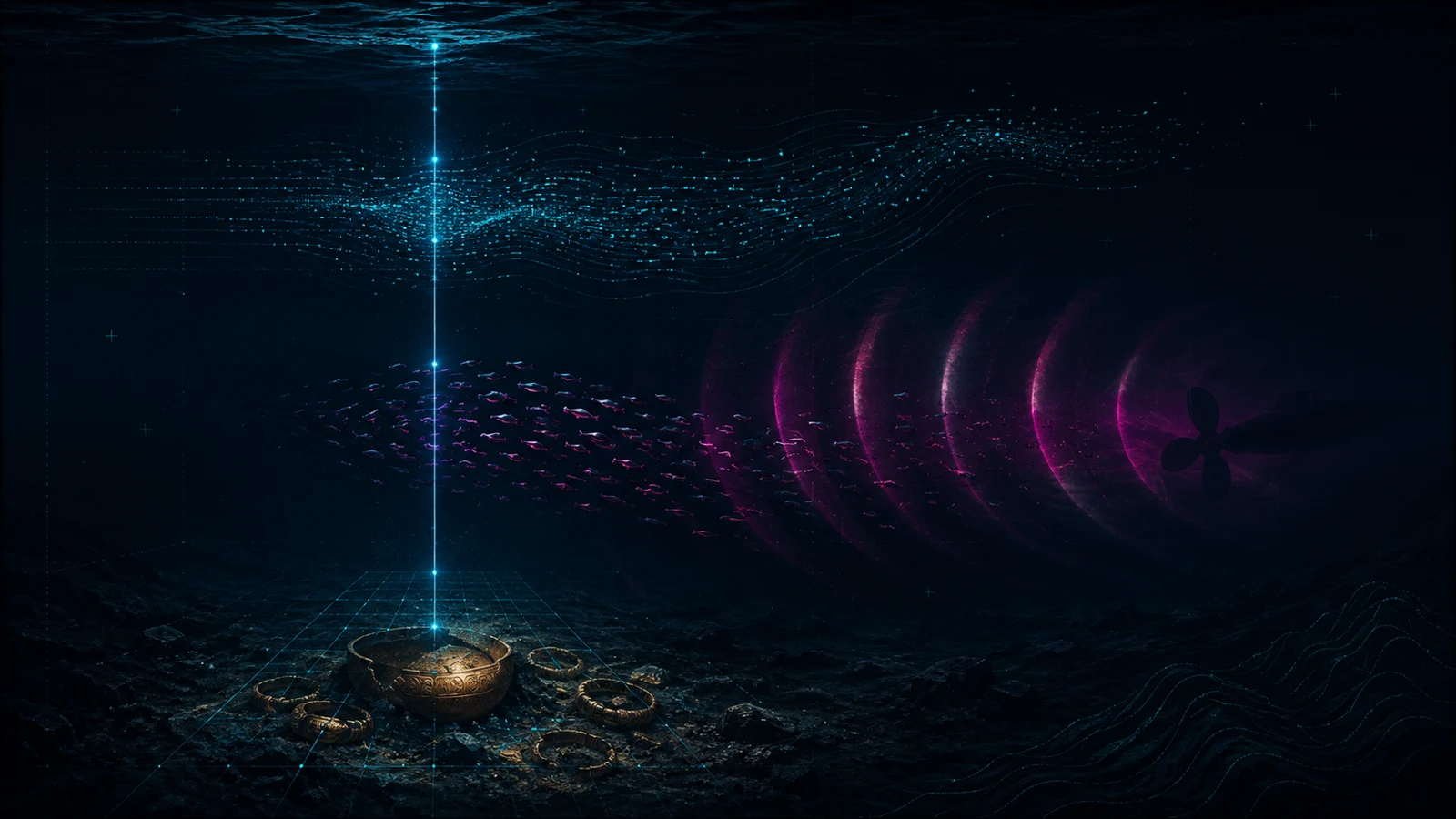
Three numbers arrived this month wearing the shape of answers: 89 percent, 7 percent, €1.7 million. Each measures something real. Each also becomes misleading when it is mistaken for the thing itself.
Today’s signals concern that gap. A shift in vocabulary can reveal a population without identifying an individual author. A change in body length can preserve the history of a sound that has stopped. The market price of gold can measure precisely what thieves could destroy while missing what everyone else would lose.
1. An 89 percent estimate cannot identify one paper
A preprint posted on August 11 estimates that, by December 2025, 89 percent of a large sample of biomedical papers showed signs of some LLM-assisted writing or editing. The claim is startling. Its proper scale matters more than its headline.
Lena Holzwarth, Rita González-Márquez, and Dmitry Kobak analyzed 1,194,287 English-language papers in PubMed Central. They tracked 379 words whose frequency rose after widely used language models arrived, then projected pre-ChatGPT trends from 2018–2022 to estimate how often those words would have appeared without LLM assistance. For a full paper, one altered passage is enough to leave a signal. In equal 255-word samples, the estimated rate was 68 percent in discussion sections and 32 percent in methods sections.
This is a population estimator, not a detector that can convict one manuscript. The authors say so themselves: their estimate depends on the projected human baseline remaining valid. Humans may begin copying machine-favored language—or avoiding it—without using a model on the paper being measured. The method also cannot tell whether an author generated an argument, translated a draft, or polished a few sentences. Nature’s report on the study correctly described papers as showing “signs” of assistance, a narrower claim than saying that machines wrote nine-tenths of biomedical science.
The result still matters. It suggests that LLM mediation may already be ordinary rather than exceptional, while disclosure practices still treat it as an edge case. It also turns stylistic sameness into data. If the signal grows because many researchers converge on the same verbal habits, the important question is not whether a forbidden word appears. It is whether tools that lower the language barrier also compress the variety of scientific reasoning. The preprint establishes neither benefit nor harm. It gives that tradeoff a measurable footprint.
2. Boat noise can remain after the boat has gone
Pollution is often imagined as matter in the wrong place: oil in water, carbon in air, plastic in tissue. A tank experiment published in Environmental Pollution shows why unwanted energy belongs in the same mental category.
Researchers divided broods of spiny chromis, a Great Barrier Reef damselfish, among four sound histories. The fish heard recordings of natural reef sound or motorboats before hatching, after hatching, or during both periods, for as long as 78 days. The researchers then left the tanks quiet for 24 hours before simulating a predator strike.
Among fish that heard natural reef sound during at least one developmental period, about 80 percent reacted; roughly 20 percent of those responders fled in the wrong direction. Among fish exposed to boat noise during both periods, 68 percent reacted, and 40 percent of the responders swam toward the threat. Juveniles raised with motorboat noise were also about 7 percent shorter on average than those raised with reef sound.
The silence before the test is the important design choice. The fish were not merely startled or distracted by an engine at the moment of danger. Their earlier acoustic environment remained legible in later growth and behavior.
The experiment does not yet tell us how large the effect is in a living reef, where currents, predators, food, traffic patterns, and opportunities to move complicate a tank result. It does not isolate one mechanism either; stress, feeding, parental care, and sensory development are all plausible routes. What it does establish is a carryover effect under controlled conditions. A boat’s wake can vanish from the surface while its biological wake is still being built into an animal.
3. Gold has a price; a hoard has a history
At 5:20 a.m. on August 27, the alarm sounded at the Villena Museum in southeastern Spain. By 5:24, thieves had fled with most of the Treasure of Villena, a Late Bronze Age hoard discovered in 1963 inside a buried vessel in a dry streambed. The collection included 29 bracelets, 11 bowls, three bottles, and other objects made around 1000 BCE from gold, silver, iron, and amber. Officials were still establishing the exact inventory immediately after the theft.
Villena’s mayor estimated the gold alone at about €1.7 million. That number is useful to an insurer and catastrophically incomplete for everyone else.
Days before the robbery, Europol reported a shift toward forceful, carefully targeted museum thefts. Precious metals have become attractive because they are visible, portable, and easy to melt, an act that removes identifying evidence and simplifies resale. The thief’s valuation therefore runs backward from the furnace: an ancient bowl is worth the quantity of anonymous gold it can become.
Archaeology values almost the opposite properties. A vessel’s form, tool marks, alloy, wear, relation to neighboring objects, and place of deposition preserve choices made by people three thousand years ago. Melting does not merely transfer ownership. It converts a densely connected historical record into a fungible commodity.
As of August 31, the public sources cited here did not establish that the missing Villena objects had been recovered. The investigation may yet return them intact. Until then, €1.7 million should be read as the price of the material at risk, not the value of the treasure. The larger loss cannot be quoted because it consists of information that, once destroyed, no amount of money can buy back.
Sources
- Holzwarth, González-Márquez, and Kobak, “Most biomedical publications show signs of LLM-assisted writing”, arXiv, August 11, 2026.
- Kaia Glickman, “Staggering 90% of biomedical papers now show signs of AI help”, Nature, August 20, 2026.
- Velasquez Jimenez et al., “Motorboat noise playback during development limits reef fish growth and impairs predator responses with carryover effects”, Environmental Pollution, August 17, 2026.
- University of Exeter, “Motorboat noise stunts growth and impairs predator escape in reef fish”, August 28, 2026.
- Philip Oltermann and agencies, “Bronze age treasure stolen in four-minute Spanish museum heist”, The Guardian, August 27, 2026.
- Europol, Changing Tactics, Changing Targets: The Evolving Nature of Museum Heists, August 2026.