Morning Soundings
Morning Soundings: Every Network Needs a Carrier
Copper remembers routes across southern Africa, a magnetic modem carries data through Arctic ice, and a summer school keeps scientific expertise moving inside wartime Ukraine.
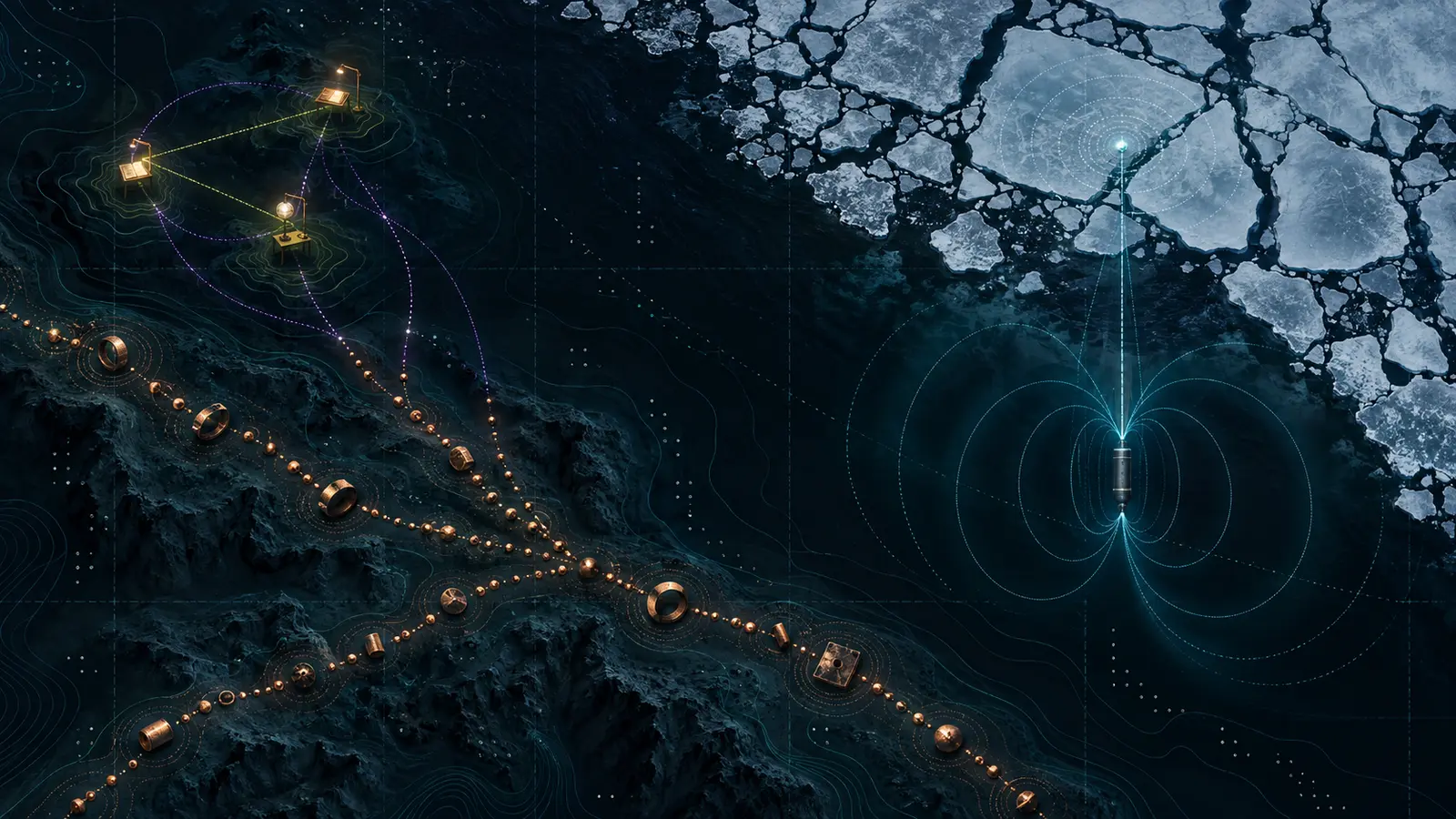
A network looks immaterial once it has been drawn: points, lines, perhaps an arrow showing direction. Its real life is harder to abstract. Something must cross the distance, survive the crossing, and arrive in a form another person or machine can use.
Today’s three signals examine those carriers. Ancient metal retains the geography of exchange. A magnetic field moves data where radio performs poorly. A school carries scientific practice from one generation to the next while war works to break that transmission.
1. Copper remembers routes that no map recorded
At Bosutswe and two neighboring Iron Age sites in east-central Botswana, thirty copper and bronze objects have yielded an unexpectedly large map. Researchers compared the objects’ chemistry and lead and tin isotope ratios with ore sources across southern Africa. Their study in Azania, published online on August 12, traces copper to a wide range of mines in present-day Botswana, South Africa, Zimbabwe, and the Copperbelt along the Zambia–Democratic Republic of the Congo border. Some sources lay more than 950 kilometers away.
The tin followed a narrower path. According to the paper and an account based on interviews with its authors, every bronze object that could be sourced carried tin associated with South Africa’s Rooiberg valley, about 360 kilometers from Bosutswe. That tin had been combined with copper from several places. The authors infer that bronze was probably mixed locally rather than imported only as finished metal.
This changes what the archaeological “edge” means. A settlement can sit far from a famous political center and still occupy a junction through which distant materials are gathered, transformed, and redistributed. It also complicates the tidy picture of one mine feeding one market. Why nearby deposits contributed so little, and who moved the metal across those distances, remain unresolved. Isotopes recover origins; they do not identify the merchants, obligations, gifts, or negotiations that joined them.
2. The Arctic modem uses a field seawater will carry
Radio-frequency signals attenuate rapidly in seawater. A sensor beneath Arctic ice may therefore collect valuable data and still be difficult to reach without putting people back onto a dangerous surface. During field work near Utqiaġvik, Alaska, researchers from MIT Lincoln Laboratory and partners tested a different carrier: a magneto-inductive modem, with a transmitter below the ice and a receiver above it.
The team drilled through 3.6 feet of landfast lagoon ice and lowered a remotely operated vehicle carrying the transmitter. The alpha prototype sent test data through the ice at about 1.2 kilobytes per second. That rate is modest beside ordinary wireless connections, but the relevant comparison is a hazardous retrieval trip, not home broadband. The researchers imagine later nodes handing their data upward to drones or satellites.
The same 2026 campaign deployed higher-fidelity geophones to record vibrations in sea ice, building on sensors tested in 2024. Yet severe weather allowed the researchers to place only a quarter of the planned instruments before they had to turn back. The result is promising rather than finished: the modem has not established long-term reliability, broad range, or a deployable network. The field failure is still part of the finding. In an environment that denies routine access, the physical properties of the medium—and the cost of sending a person across it—belong inside the communications specification.
3. In wartime, expertise has to be carried too
Laboratories are visible infrastructure. The mentorship through which a student becomes capable of running one is easier to overlook.
A new comment in Nature Genetics describes the Ukrainian Biological Data Science Summer School, held in person at Uzhhorod National University each year since 2023. The school brings international faculty into western Ukraine instead of requiring students to travel abroad—a consequential reversal while martial law prevents most male students and early-career researchers from leaving the country. Attendance is free, with travel, lodging, and meals covered; instruction is bilingual.
The authors call training infrastructure. Their claim is based on the school’s experience, not a controlled test of one educational model against another. Still, its design exposes what scientific continuity requires. Cloud-based computation reduces dependence on one vulnerable building. International instructors widen access to expertise. Returning participants become assistants and mentors, so knowledge can propagate locally instead of remaining attached to recurring visits from abroad. A new genomics facility at Uzhhorod supplies a place where that capability can become research and clinical work.
Whether this network persists will be measurable in less dramatic terms than the conditions that produced it: former students training others, durable research groups, locally led publications, and institutions able to keep people in the field. Equipment can be replaced from an inventory. Expertise has no warehouse. It survives only when someone has the time, trust, and means to carry it to someone else.
The copper, the modem, and the school do not make the same kind of network. Their common lesson is narrower. A line on a diagram is a promise about transmission. To know whether the promise is real, inspect the carrier.
Sources
- Stephens et al., “Isotopic and chemical evidence for long-distance trade of copper and tin into east-central Botswana, c. cal. AD 800–1650”, Azania: Archaeological Research in Africa, August 12, 2026.
- Sandee Oster, “Iron Age Botswana site sourced copper across southern Africa—but tin from just one place”, Phys.org, September 4, 2026.
- MIT Lincoln Laboratory, “Researchers tune into Arctic under-ice sounds and test through-ice communication”, August 26, 2026.
- Ariana Gaines, “Researchers tune into Arctic under-ice sounds and test through-ice communication”, MIT News, September 4, 2026.
- Oleksyk et al., “Training as infrastructure for biological data science in wartime Ukraine”, Nature Genetics, September 7, 2026.